
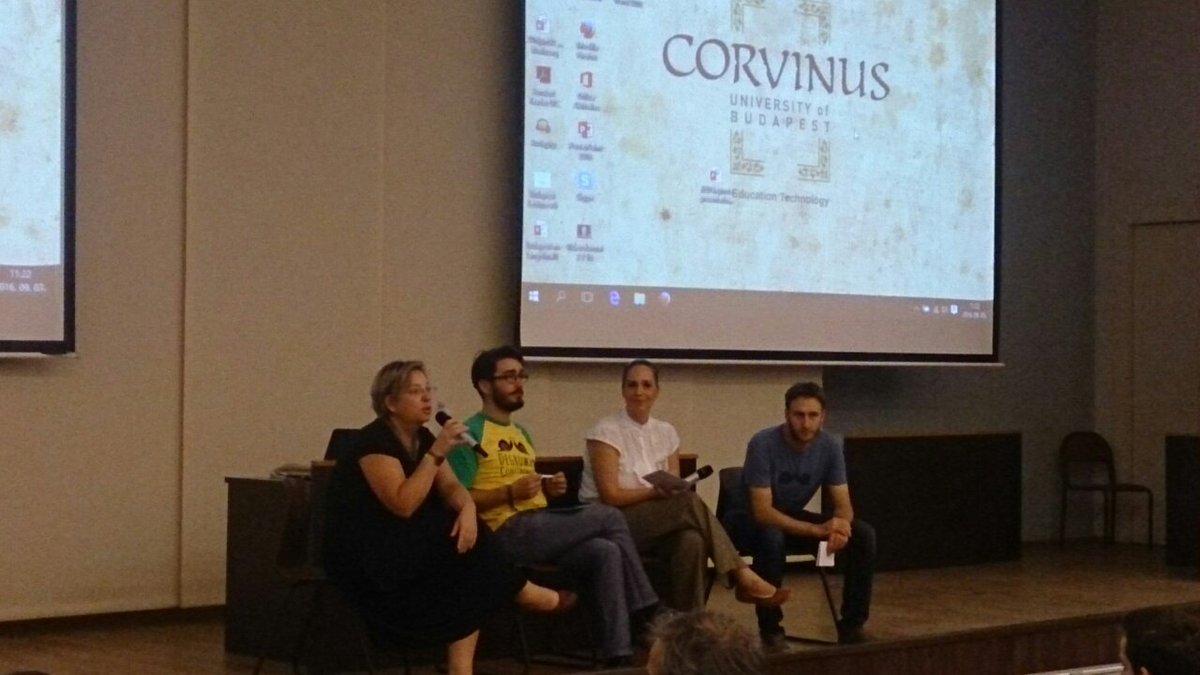
As Vincent Ligey, coordinator of the Budapest Conference organizing team mentioned in the closing plenary, it was an experiment to hold an international degrowth conference in a former socialist country where the soil for degrowth ideas is not particularly fertile. The more it came as a surprise that the conference had received a widespread coverage in Hungarian media.
Szandra Koves, press outreach coordinator of the organizing team, reported the incredible number of over 100 appearances in Hungarian press all over the political spectrum with an outreach to different types of audiences. This mirrors a considerable interest of the general public at large to which the concept of degrowth is mainly a new and somewhat strange idea, which was also reflected in the most frequently asked questions by journalists which were:
An interesting Freudian slip of some, apparently due to the Hungarian language, was to mix up the term degrowth with de-development, which makes sense from a post-development point of view, but is rather off-putting for Hungarian journalists. Kovas explained that, especially in a country where people are very much used to top-down approaches as well as quite disillusioned with politics, the question about initiating change is tricky, because claims for bottom-up approaches are still a novelty and might also evoke feelings of guilt in people.
Another interesting observation she made was the frequent mentioning of the unconditional basic income (UBI) in connection with degrowth, which shows that new ideas quickly spread in Hungary, considering that the UBI was unknown until a few years ago.
"Marxist esoterism" versus "The voice of the 21st century"Another interesting source of insight into the perception of degrowth in the Hungarian public were the comments made in the media: while some were sympathetic but sceptic, many others expressed a widespread fear of losing securities. Some even put degrowth in the proximity of National Socialism. Some others assumed that degrowthers must either be communists or hippies, "Marxist esoterism" being the funniest and most creative way to express this. On the positive side, Kovas mentioned two exemplary comments. "That's the voice of the 21st century" and "Where can I join the movement?"
Some reflections from participantsWhile many participants particularly enjoyed the convivial and decentral set-up of the conference that integrated many alternative locations in Budapest and even events in other parts of the world, others missed dedicated spaces for interaction between academics, activists and practitioners. In the closing plenary, many suggested to include more interactive formats into the next degrowth conference.
Ashish Kothari from India appreciated the opportunity provided by this conference to learn more about Eastern Europe, also stressing the need for more and longer informal discussions between disciplines and cultures. As already mentioned in his keynote, he reiterated the idea of holding a global forum on alternatives, maybe in the global South, and added that he had missed so-called refugees and workers at the conference.
Impossible to decolonize our imaginaries within five daysOn the difficulty of integrating the different expectations and visions of a degrowth conference held in a true degrowth-manner, Vincent Liegey said that it is merely impossible to decolonize our imaginaries in only five days: "We come from societies where we are conditioned to be stupid, so we have to collectively and individually create pathways into a new world. We have to be humble and cannot do everything at the same time. While we succeeded on some things, we failed on others. It might even be better that we have no exact definition ofdegrowth – I definitely want to live in a world with a lot of enjoyment, love and also conflicts in dynamic ways."
In sum, for most participants it was a great experience to be at this conference which had its own spirit, very different from the Leipzig one. In the words of Gualter Baptista who participated in the organization of both: "Leipzig is hard to beat in organisation and participation; Budapest will be hard to beat in conviviality!"
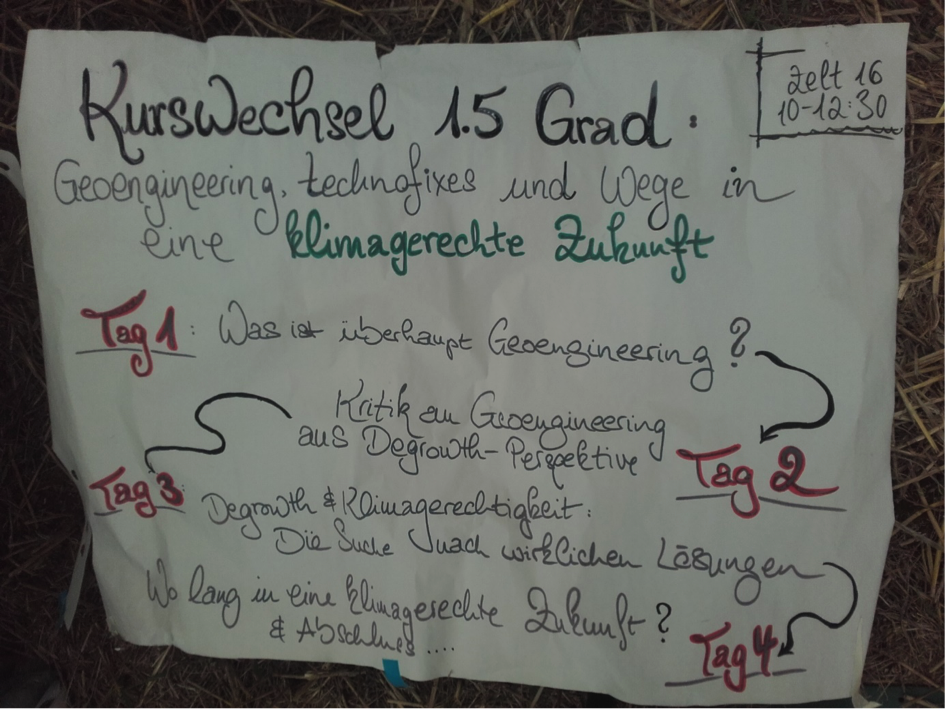
Linda Schneider reflects on Geoengineering Monitor about a workshop on geoengineering from a degrowth and climate justice perspective at Degrowth Summer School in Rhineland, Germany: http://www.geoengineeringmonitor.org/2017/09/workshop-geoengineering-from-a-degrowth-and-climate-justice-perspective/ Geoengineering Monitor aims to be a timely source for information and critical perspect...
Gemüsekooperative Rote Beete [Vegetable Cooperative „Rote Beete“] from Marc Menningmann on Vimeo. What has agriculture to do with the climate? A lot. Modern, industrialized agriculture is heavily dependent on fossil fuels. This video shows an excursion which took place in the context of the Degrowth Conference in Leipzig last year. Participants visited the vegetable cooperative "Rote Beete" o...
What does degrowth mean to you? By Marc Menningmann In this video, some of the scientists, activists and ordinary other participants who gathered at last year's Degrowth Conference in Leipzig share their personal understanding of degrowth. It shows how many different facets degrowth can have. Now we have added English subtitles to it which can be activated by clicking on the little green b...