
On 14 March the last submission period closed for contributions to the conference. After a first quick review it was already clear that all expectations were far exceeded: more than 350 scientific papers were received from a broad range of disciplines such as economics, psychology, geography and urban planning. Further 260 proposals for practice-based activities were submitted by various civil-society organizations and initiatives. The majority of the contributions came from European countries, although there were also submissions from Japan, India,Mexico, Brazil and the United States.
Professor Tim Jackson, author of „Prosperity without Growth“, and member of the conference’s advisory board, sees the conference as an important step towards overcoming the growth paradigm: „I hope that this conference will help shape a positive vision of an equitable and sustainable post-growth society“. Nina Treu, programme coordinator of the conference, is pleased: “The high number of contributions shows the great interest in the topic. I am sure that now we can put together a conference programme with many superb presentations and activities.”
At the conference there will be seven keynote-speeches and more than 20 panel discussions. Around 250 activities will take place on the basis of the received submissions, in addition to an inspiring artistic programme. Confirmed speakers are among others Naomi Klein, Sunita Narain, Alberto Acosta, Esperanza Martinez, Harald Welzer, Joan Martinez-Alier and Angelika Zahrnt.

Every day we are bombarded with frightening news. But how do we personally feel about them and how can we deal with them as society as a whole? Which future do I actually want for myself, for the world and for my children? And how are my personal feelings and motivations connected to the larger picture? What frightens me, what makes me angry and how can I transform these feelings into a source ...
More than a year ago the 4th International Degrowth Conference for Ecological Sustainability and Social Equity took place in Leipzig. Now the jubilee video "Metamorphoses" is available with english subtitles: Metamorphosen [Metamorphoses] from Marc Menningmann on Vimeo. At the opening of the Degrowth Conference 2014 the sound-artist Pablo Paolo Kilian preformed his piece of music "Metamo...
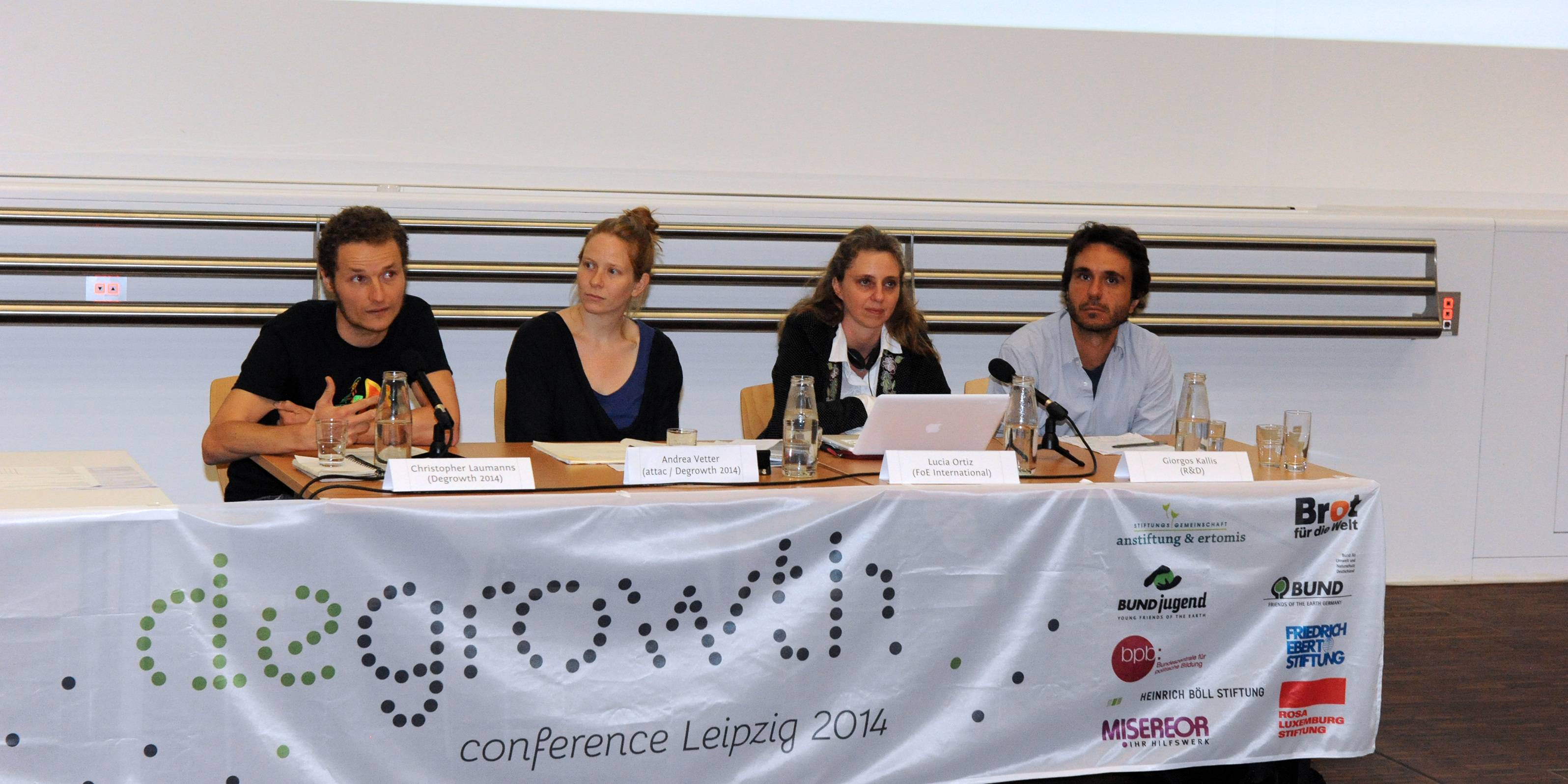
By Christiane Kliemann At the end of a conference like this, there might be as many impressions and insights to take home as there are participants, and so it is almost impossible to nail this rich variety down to a few one-dimensional bullet-points. What seemed to unite the findings of the various reporters, however, was the perception that the multitude and diversity of the represented appro...