
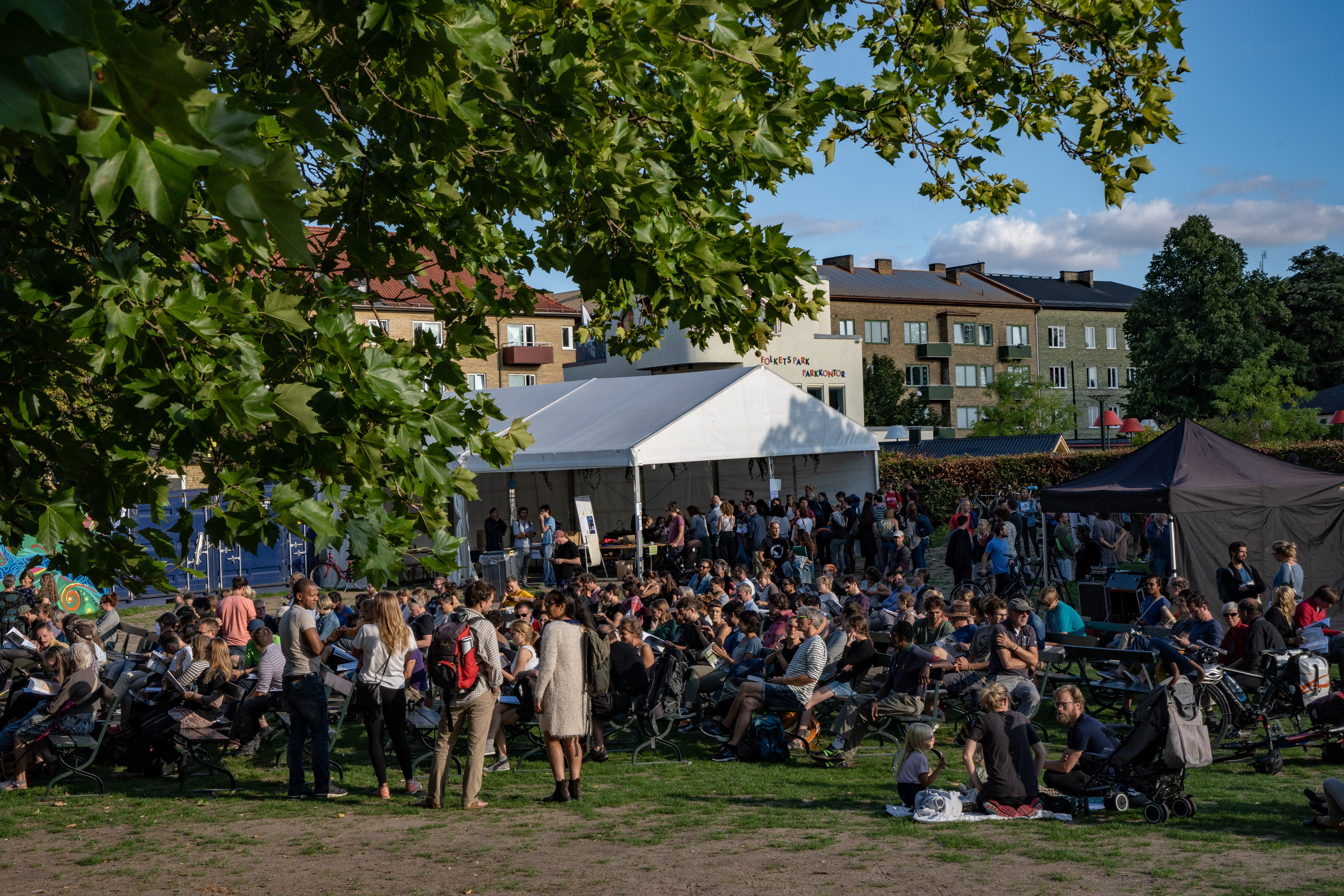
The 6th International Degrowth Conference finished on Saturday, the 25th of August with a demonstration under the rain in the center of Malmö. Typical weather for the end of August in Sweden, and very welcomed after the past worryingly dry months. The subtitle 'Dialogues in Turbulent Times' would summarize the week quite well. The strangely hot summer experienced by all of us was frequently used by the different speakers when giving emotional arguments. The different debates evidenced the long distance along the spectrum of perspectives and disciplines within the degrowth movement. Although I have been engaged with Degrowth for quite some time, this was the first Degrowth conference I attended. This article is my attempt to summarize the main aspects of the conference from the eyes of a first timer. Malmö was presented as the perfect spot to host an international Degrowth Conference. With around 40 % of the population categorized as immigrants, Malmö is a diverse city which was defined as the “hub of activism” by several of the Swedish speakers. It is also highly segregated, but Folkets park, the venue of the conference, is a place where all cultures meet. The organizers of the conference did a conscious effort in their choices to keep to the degrowth standards, ordering beer from local breweries, and providing food from a “food waste” catering run mostly by volunteers (Rude Food) and Yalla Trappan, a “social enterprise” which hires only women who have immigrated to Sweden. Yet, degrowth is a rather foreign concept to the Swedish society, as the invited Swedish politicians admitted. The concept was regarded with certain skepticism, even by the critical scholars working at the Human Ecology division of the neighboring university of Lund. A movement that started in France and spread in southern and central Europe, it did obviously not reach the so-called progressive Scandinavian states with the same ease. An argument mentioned several times by different Swedish contributors, both from the political and the academic spheres, was that “yes, we need degrowth in certain sectors of the economy, but growth in others”. One wonders whether they had a closer look at the degrowth ideas or not. There seemed to be a fear to renounce the comfortable Swedish standards of living. Or maybe just a misunderstanding of what is meant by “degrowth”. Interestingly, demonstrations for “noll tillväxt”, translates as “zero growth”, which took place in the 70s in Sweden, during the global oil crisis was not mentioned during the conference. The upcoming Swedish election gave a special context to the conference despite a mostly non-swedish participation. Several politicians were invited in a couple of occasions, such as in the opening of the conference. Showing little acquaintance with the degrowth ideas, they made rather conventional and non-radical points in an attempt to appeal to the electorate. I want to think they could have performed better in a context released of electoral campaigning stress. Swedish scholars also referred to the 9th of September - aka, the day of the election. But the conference was not only about Swedish politics. The program was full with a range of topics, including not only academic but also activist and artistic presentations. With around 15 parallel sessions in each time slot, different perspectives on degrowth and its relation to feminism, welfare, technology, inequality, happiness, just to mention some, were presented and discussed. Degrowth seemed to have become the focus of more disciplines. Networking events also took place, for example, the first international meeting of the Feminism and Degrowth Alliance (FaDA). However, the conference was mainly academic. The discussions were rather theoretical, the participants were highly educated, and needless to say, primarily based in the Global North. The format remained overall quite conventional: many presentations, and little time for participatory input. Again, the question of a top-down let transition comes up, and the spread of the movement to a broader and more diverse basis of society remains to be seen. More participatory formats could be further considered for future events. A connected and recurring topic was the need to work for degrowth within a “growth society”. Is it possible? Opinions were diverse. Several initiatives which could be described as following the degrowth ideals popping up in several places were given, while others put the focus on bringing the idea to the political sphere. Meanwhile, the vast majority of our societies remain strangers to the concept. Andreas Malm described the “degrowth momentum” as the intersection of academic studies and environmental activism, a statement loudly applauded by the crowd. Differently, Lynne Segal compared “the degrowth ideology” with faith, with religion - “a way of living, a reason to live”. Is degrowth a movement? And if so, an exclusive one? This should be answered on another text. Nonetheless, this year was quite important for degrowth. 'Dialogues in turbulent times' had more than 700 participants, and it was only the first of three international conferences taking place before the end of the year. Degrowth seems to be growing (excuse the redundancy).
Schon zum zweiten Mal gibt es dieses Jahr die Degrowth-Sommerschule auf dem Klimacamp im Rheinland. Während sie letztes Jahr ganz im Zeichen von Klimagerechtigkeit stand, heißt sie diese Jahr „Skills for System Change“. Wir haben bei Christopher Laumanns vom Orga-Team nachgefragt, warum das so ist, und was Euch auf der Sommerschule erwartet. Warum ist der Zusammenschluss von Degrowth und d...
Von Dennis Eversberg und Matthias Schmelzer Auch wenn Wachstumskritik en vogue ist – in einer Rangliste der „Top 10 Grassroots Movements“ des australischen „Shift Magazine“ nahm es jüngst sogar den ersten Platz ein – gibt es zu Degrowth als einer sozialen Bewegung bisher kaum Forschungen. In einem neu erscheinenden Aufsatz im Forschungsjournal Soziale Bewegungen präsentieren wir – basierend a...
Eine Sendung des unabhängigen Nachrichtenmagazins Kontext TV zur Degrowth Konferenz: Quelle: www.kontext-tv.de "Wir brauchen ein neues Wirtschaftsmodell": Naomi Klein über Klimachaos, die Grenzen des Wachstums und eine neue globale Bewegung Wenn wir den derzeitigen Wachstumspfad fortsetzen, wird sich laut Weltbank und Internationaler Energieagentur die Erdatmosphäre bis 2...