
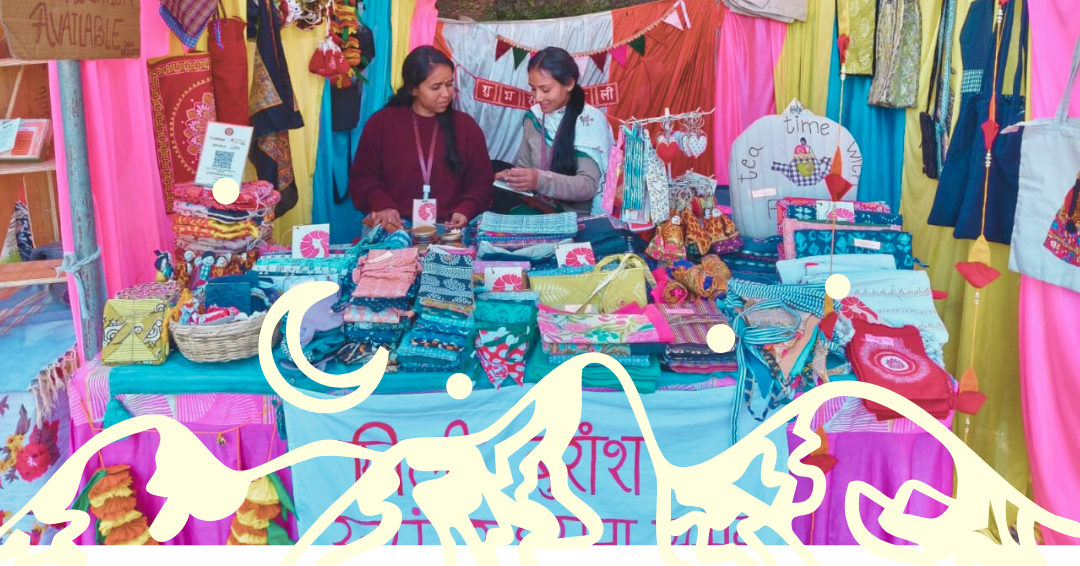
Khili Buransh's members setting up a stall and selling their products. Image Source: Rohini Dutta
A group of women in a remote Himalayan village in Uttarakhand, India, step out of their homes and into Khili Buransh, a space known for its positive atmosphere. Together, they have shaped this place for work, leisure, happiness, and everything in between. In return, it has given them identity, recognition, and a livelihood—a space they can truly call their own. The collective produces high-quality handcrafted products, including laptop sleeves, table and mattress linens, cushion covers, tote bags, pouches, aprons, gift items, and other customised goods.
A board titled Khili Buransh (Hindi for a blooming rhododendron) hangs aesthetically on the exterior of the store. It highlights a thoughtfully designed logo – a face with wavy hair resembling the flower rhododendron. The petals of the flower are in varied sizes, implying the diversity and inclusivity of the group. Painted Aipan art (a folk art that traditionally used ground rice and red clay) beautifully frames the structure.
Five women sit on colourful handmade cushions, operating their sewing machines. Characterising their creativity and high spirits are bunting, hangings, flags, adorable little dolls, and bags displayed as samples of their creations in their store. The operational area barely fits all five of them, and a store (with crammed showcases and uncovered shelves) displays their products, which are very much a reflection of the women’s lives. Inadequate support for their pursuits is indicated by the store’s need for more furniture to display and safely store their creations. Despite high potential to stand out, these women struggle for acknowledgement. Yet, they carry an optimistic and unwavering attitude.
The collective, Khili Burash, has five permanent female members of diverse ages, educational backgrounds, financial backgrounds, and marital statuses. Trainees and others join and leave time and again. Collectives in this part of the world are registered under an act of law as a Swayam Sahayata Samooh, which means a Self-Help Group (SHG). The registration offers them a formal standing to trade, transact, gain benefits, and receive training from government and public schemes. The most common form of SHG seen around here is one in which women save money collectively to support each other in times of financial need. In spite of the scheme displaying a communal form of financial interdependence supported by the local governance, it has loopholes in which women seem like mere pawns in the game designed and played by oppressive systems such as patriarchy, social structures, and corrupt intermediaries, such as a scam run by the leader of a self-help group!
That’s exactly where Khili Burash stands apart. The group was crafted by Jaya, Atul, Tautik, and Rohini to aid the creation of autonomy, agency, and collective self-reliance in these women joining the group.
Jaya and Atul, a couple with ancestral roots in the mountains, chose to return from the plains to a small village named Seem post their retirement. As new settlers, they felt a responsibility towards the village and community. Hence, they set up a children’s library out of their savings and support from family and friends. Today, the Happy Children’s Library is more than a place from where one borrows books; it holds the surrounding villages together. It has turned into a learning centre, community space, and an incubator of ideas for the village. Khili Burash was incubated at this very place and, in fact, continued to operate from there for an entire two years.
It can be attributed to the couple’s generosity and approachability that a few young girls who often visited the library took up the initiative to seek their aid. Although sewing and stitching were common practices among the women in the villages, doing them professionally wasn’t seen around much. Jaya and Atul encouraged the girls’ interest by asking Tautik and Rohini, experienced consultants and graduates from the National Institute of Fashion Technology, the top fashion school of India, to facilitate a three-month-long sewing workshop. The entire set-up, consisting of materials, machines, and finances, was arranged by Jaya and Atul. The workshop, attended by numerous women from the surrounding villages, eventually gave birth to the self-help group that’s currently Khili Burash.
Tautik has expertise in apparel manufacturing, leading projects with the United Nations Development Programme (UNDP) and the World Bank in countries such as Pakistan and Bangladesh. After gaining extensive experience in the sector, he and his partner, Rohini, travelled across India. The exposure transformed Tautik’s outlook, especially as he recognised the industry’s environmental and well-being costs. Together, Rohini and Tautik chose to leave the corporate apparel world behind for a new purpose.
Drawing on their diverse experiences, Jaya, Atul, Tautik, and Rohini established Khili Buransh based on shared values. Jaya and Rohini stood as an example of female empowerment! Although Rohini couldn’t join Tautik in training the women full-time, she took up the role of mentoring them periodically. The training aimed to empower women with product development, sales, finance, and communication skills, going beyond prioritising income to focus on overall well-being. Jaya emphasised that the founding team wanted to avoid a factory-like environment or poor working conditions and made conscious decisions, like rejecting bulk orders, to prioritise their principles.
The group required guidance and help with decision-making during its initial stages. In India, being at the crossroads between modernity and traditional ways of living, a woman’s lifestyle and exposure that enable her to move out of the conditioning of patriarchal and societal norms vary regionally - from urban to rural areas - and according to factors like formal education, generation, and family setup, i.e. nuclear or joint families.
In the context of rural areas of north Indian villages, most women belong to households where patriarchal decision-making systems exist. The head of the family, the primary decision-maker, is typically an older male member, and the hierarchy follows with older generations and men in the family having more power, and women (especially the daughters-in-law in this context) placed at the bottom-most level. The women who are designated to be caregivers by the families are expected to fulfil the needs of everybody else in the same patriarchal pattern by placing their personal needs and well-being aside! In a family, the younger women are the ones with the least power, especially in financial decision-making.
Agency and autonomy are limited to such a level that a married woman needs to seek permission to visit her paternal family (parents) and make arrangements for her marital family (in-laws) to function properly in her absence. A girl is conditioned from a young age to prioritise others’ expectations and is stripped of her ability to decide for herself.
Tautik and another woman from the village shared a couple of incidents of young women in this region being pulled into scams and facing serious consequences, such as debt or difficult jobs. Due to their environment and living conditions, the women in these Himalayan regions often lack exposure to experiences that help distinguish between genuine and misleading situations. As a result, they may be more susceptible to deception, negative influences, and exploitation.
Building on the challenges, Khili Buransh’s founding team aimed to guide the women’s transition from being dependent to self-reliant decision-makers. As a result, women gradually took control and achieved empowerment in a true sense. Citing Tautik, “because of patriarchal families, these women do not have much cash in hand, they need to ask their fathers, elder brothers, or, in case of married ladies, their husbands for the simplest of needs, such as even getting their phones recharged. In the case of Samooh, now the ladies have cash to spend on themselves or their children”. Jaya recalls that the most exciting part for the women was to handle their banking transactions when the Samooh began selling its products.
One of the primary steps taken in this process was to train the women to offer apprenticeships to new individuals who wished to join the group. Growing from creators to trainers gave them a confidence boost, and it also helped them track the group’s product quality. They learnt to maintain a journal of accounts, records of the group’s transactions, costs, payments, and profit sharing. Tautik explains that during the first year of operations, the Samooh’s higher profit was a result of orders placed through the founding members’ networks. The elevated profits and income in hand boosted the women’s enthusiasm and confidence, which helped the group market and position their products on online markets despite still learning and experimenting. On the other hand, the group's transition into self-reliance led to fewer orders and lower profits, as they were in the slow process of establishing an organic market.
The biggest hurdle arrived when the group was asked to vacate the library’s premises, as the library needed more space for its activities. Operating away from the founding team meant the group was fully responsible for itself.
Jaya and the team feared the group might break apart, and it did. The original group included women from two villages, Seem and Biyasi—the so-called upper and lower caste villages. Prema, a Biyasi member, offered part of her home for the group’s work. The location was promising for the new setup. However, upper-caste villagers from Seem left the group. They were unwilling to work from a village considered to be from the lower sections of society. The Biyasi women continued as a smaller group under the Khili Burash trademark, operating from their village.
Jaya and Tautik were heartbroken, as they had always thought that the initiative had erased such casteist differences and portrayed an ideal example of communal harmony. Yet, they stood with the women of Biyasi. Khili Burash came back into action stronger and for the better! As an attribute to inclusivity and equality, the newly formed group kept its doors open to anyone and everyone who wished to join them.
Prema, the designated secretary, is currently the senior-most member of the Samooh and takes pride in sharing her joy when people recognise her through Khili Burash. Her internal insecurity and discomfort with caste-based discrimination only got stronger due to the incident. Prema, Rekha, and Sushila are married ladies and mothers in the group, proudly claiming that the Samooh has given them an identity and proud recognition in their children’s eyes. Not only has the Samooh given the women a livelihood and income, but Rekha pays her son’s school fees, Prema saves up her earnings, and another younger member, Shaili, asserts that earnings from the Samooh covered the fees of her post-graduation degree, but also generated opportunities to establish and secure one’s future.
Although the women’s families are now accepting of their work, each individual silently wishes that their families and societies would encourage and support their pursuits better. One of the married women expresses how she wishes she could seek her husband’s support for her desires in life, which are as simple as following her passion for creating. The sad reality of capitalism is that the success of a person is always measured in terms of the monetary rewards they bring. Since the Samooh currently does not generate a lot of revenue like a business set up would, the villagers and many families consider the women to be wasting their time being a part of this group. The collective often faces objections like “why don’t you accomplish your household chores and tasks effectively rather than choosing to work for peanuts in return?” Another younger member, who walks to the store from a different village, gets taunted and told to pursue a job elsewhere, perhaps in a city, rather than working at the Khili Burash all day for low pay.
For the women, it remains an act of courage, rebellion, and everyday hardship to continue being part of the Samooh. Despite all of it, five established women - Shaili, Bhavna, Prema, Rekha, and Sushila - show up every day crisply dressed and with a zeal to take on the day’s activities. The women work in structured synchrony; moreover, they understand each other’s priorities, limitations, and abilities, so they share and help each other with the work accordingly. The group is a package of strengths and insecurities where one person covers for and supports another. Half of them prefer perfectionism, while the rest choose experimentation. The diverse group has its methods of conflict resolution/management. They try to go by the majority but also give prominence to the method of consensual decision-making. The one who wants to stand apart is not stopped from their experiments. The success of an experiment is a great discovery, and it is considered okay to fail.
An important principle introduced by Tautik to the group is that growth extends beyond profit. Khili Burash holds a powerful belief that growth involves spreading knowledge widely. According to the group, growth means collaborating with more women, yielding higher production, increased stock, and greater visibility. Khili Burash holds a clear vision about not wanting to grow in an exploitative manner at the cost of social, personal, and ecological well-being. The Samooh is a mindful producer and consumer, especially in terms of procurement and logistics. The group sources its raw materials from a nearby wholesale market, minimising associated transportation costs. Working from orders means that waste is minimised, and all scrap fabric gets used as fillings.
An unmarried woman joining the Samooh often moves out of the group post her marriage, since it is a customary traditional practice in India for a woman to relocate to her husband’s residence after marriage. When asked about it and the group’s continuity, Tautik explains, “Our training aims to empower each woman with skills so she can thrive, regardless of her location or profession.” He adds that the group’s functionality will not be affected if any of its members voluntarily departs. Jaya echoes this, stating, “The Samooh will endure, regardless of its size, as each woman is equipped to manage every aspect of operations.” This is a key strength: every trained member is knowledgeable about all facets of production and management. The women even envision another village group acquiring these skills to form a similar collective under the same brand, enabling coordinated marketing and increased earnings.
Khili Buransh began by selling to those with purchasing power, who relocated from urban areas or ordered remotely through ties with the Happy Children’s Library. Now, the group also sews and stitches for local residents, besides setting up temporary stalls during out-of-station events. Pricing varies with buyers’ purchasing power, but these combined sales strategies have produced steady income and made operations more local and interconnected.
Most importantly, being part of Khili Burash helps these women with their personal development and growth: identity as an established person, agency to make decisions, and being respected for what they bring to the table. Satisfaction comes from being in a position to care for themselves and support their family’s needs. Happiness is taking a break from work without having to explain, laughing in leisure, and ranting about everything and anything they wish. The members’ goals are: a life of their choice, pride in their children’s eyes, supportive partners and husbands, and a non-judgmental, or rather, appreciative, society.
Jaya, Tautik, and their team set an example of what it means to share one’s privileges and knowledge to enhance another’s working conditions and well-being. As a group and initiative, Khili Buransh is leading a silent revolution against the capital-intensive, extractive, exploitative, patriarchal, casteist system prevailing in their part of society.
This post is part of a mini series on which The Himalaya Collective collaborates with degrowth.info. Together, we aim to forge connections between individuals and groups striving to achieve alternative economic and social systems both locally and globally, and to highlight real-life practices inspirational to the degrowth movement. You may read this post on the Himalaya Collective’s website, in English or in Hindi. You may also read the other pieces of the series here:

By weakening the Corporate Sustainability Due Diligence Directive, EU policies reinforce extractive relationships and sacrifice zones.

While degrowth aims to be a convivial movement with care, justice and solidarity at its centre, it is not immune to conflicts and abuses. This article reflects on the different ways the degrowth movement can respond to harm.

In the last decades, scholarship on degrowth, as an antithesis to capitalism, has grown in volume. But critique of capitalism cannot alone solve problems of modern society across the Global North and the Global South. Degrowth needs to be developed at multiple levels through an inclusive policy framework, where citizens' participation is crucial in order to push towards the construction of a degrowth society.