
A new Left has to be an ecological Left, or it won’t be left at all. Environmental change ‘changes everything’ for the Left too, Naomi Klein argued. Capitalism requires constant expansion, an expansion predicated on exploitation of humans and non-humans, that irreversibly damages the climate. A non-capitalist economy will have to sustain itself while contracting. But how can we redistribute or secure meaningful work without growth? There is not yet a concrete ‘economics of degrowth’. Lamentably, Keynesianism is the most powerful tool the Left, even the Marxist Left, has for dealing with issues of policy. But this is an economics of the 1930s when unlimited expansion was still possible and desirable.
Read the whole article in the New Internationalist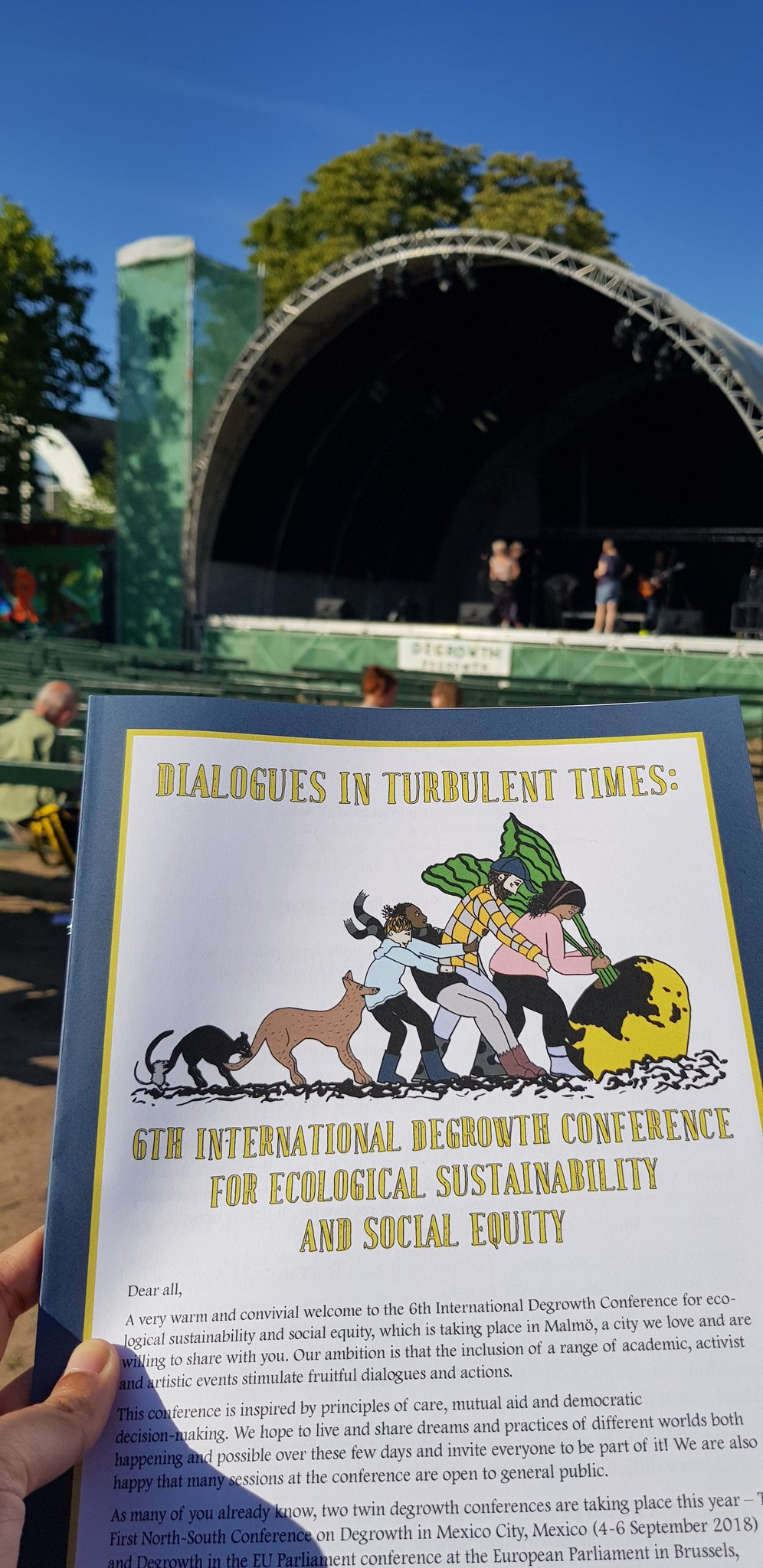
Last week, from the 21st until the 25th of August 2018, the 6th International Degrowth Conference for Ecological Sustainability and Social Equity took place in Malmö, Sweden. It was organized by an international group and the newly formed Institutet för nerväxtstudier (Institute for degrowth studies). Around 800 people discussed about "Dialogues in turbulent times". This article will give you a...
By Xavier Renou Civil disobedience shares a lot with the degrowth idea and movement. In the past, civil disobedience proved to be a powerful tool to fight for equal rights, labor rights, independence, peace and political liberation. Thanks to a growing awareness, an increasing number of struggles involving civil disobedience and non-violent direct actions have been influenced by if not conduct...
Die Krise der gesellschaftlichen Naturverhältnisse ist auch eine Krise der gesellschaftlichen ReProduktionsverhältnisse. Dies ist der Ausgangspunkt der queer-feministischen Kritik an den alternativen Ansätzen, die unter den Schlagworten Green New Deal, Postwachstum oder Solidarische Ökonomie verhandelt werden. Während die Strategien des Green New Deal auf eine ökologische Modernisierung der Industriepolitik abzielen, stellen Postwachstumsdebatte und Solidarische Ökonomien [...]