
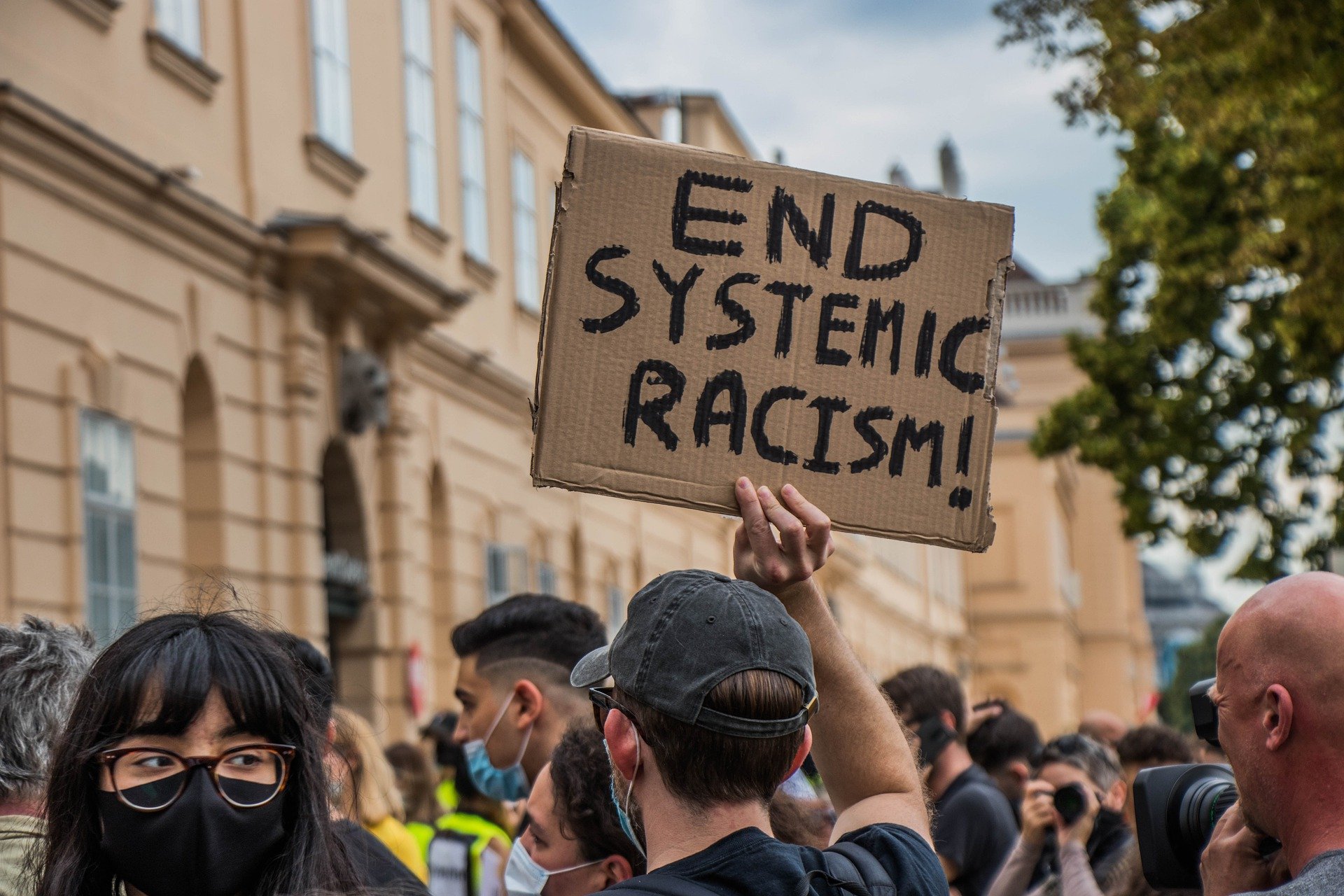
We, organizers and participants at the Degrowth Vienna 2020 conference demand equity and justice. We stand in solidarity with the people in the United States challenging white supremacist culture and with related global struggles. As activists, academics, artists, and practitioners we aim together to put an end to systemic oppression and structural racism; as again has been recently revealed by the murders of George Floyd, Breonna Taylor or Ahmad Auber. The conference expresses its global solidarity with all victims of police violence and systemic racism, and supports the antifascist movements facing criminalization. Racism and coercion are political issues that cannot be tackled on a moral basis only. This murder is the result of an oppressive and exploitative system where racism and coercion are key in maintaining domination and the exploitation of women, Black, Indigenous and People of Color (BIPOC) and historically marginalized trans-/queer/non-binary people, people with disabilities, the working-class, and natures. Ending systemic racism is a liberatory means towards human emancipation. This requires the rejection of a policing system based on the devalorization of human beings as well as the destruction of nature, for the sake of capital accumulation through a white supremacist culture by political and economic elites. Overcoming systemic racism includes the rejection of the prison-industrial complex, reinforcing capitalist exploitation by criminalizing lives. It additionally calls for a transformation of the organisation of executive functions, away from oppression, and instead centred on the protection of human rights. We recognise that degrowth as a movement is still white dominated and euro-centered, and thus susceptible to the same structural discrimination that plagues our systems. We commit to work consciously as a community to address and improve in regards to racism internally. As a movement we fight for a world where every human and non-human being — of any colour, any gender, any sex and/or sexual orientation, any ableness, no matter of their geographic and social origins, beliefs or opinions — is entitled to dignity and to a meaningful and decent life. Thus, the degrowth movement fully embraces the claims of the protestors throughout the United States and beyond and expresses its support. With the awareness that our paths are still detached, we aim to advance our convergence and struggle forth in unity.

There’s lots of talk recently about the wealth of Jeff Bezos. There are maps comparing his wealth to entire countries, a “You are Jeff Bezos” game where you can spend his money on different things - like paying their fair-share of taxes, and a graphic that puts his wealth in perspective. A recurring point is that most people simply cannot fathom the amount of money he has. The number is $150...

At the recent World Economic Forum (WEF), a gathering of business and political leaders in Davos, it was noteworthy that WEF Director, Klaus Schwab, attempted to integrate ‘time’ into his diagnosis of the ecological crisis. "Shorter terms of office cut time horizons for decision-makers. The urgent scientific message on climate change finds it hard to cut through the news cycle." Schwab’s...

Middle-Europe's prosperity as well as our high levels of mobility and consumption are based on three industrial revolutions whose technical progress has constantly been increasing labour productivity. The consequences are paradoxical: On one hand it is possible to produce ever more goods with the same amount of work. On the other hand these productivity increases are being used to make human la...