
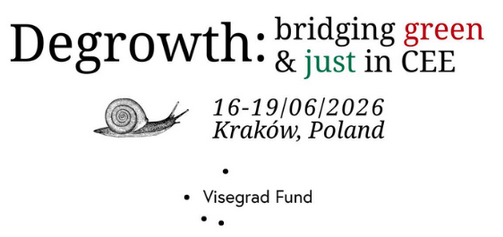
When? June 16-19, 2026
Where? Krakow, Poland
Across Central and Eastern Europe, people are experiencing overlapping crises: rising living costs, environmental degradation, work precarity and growing inequalities. Climate and economic transformations are often presented as trade-offs – between satisfying social needs and caring for the environment. Yet many social movements, trade unions, community initiatives and researchers are asking a shared question: how can we ensure good life for all within planetary boundaries? Degrowth offers a framework to imagine a green and just transition that prioritises well-being, care and fairness over endless economic growth, rejecting the need for “sacrifices”.
As a social movement and practice, as well as a field of academic research, degrowth is becoming an increasingly clear and serious proposition, yet it is still mainly voiced by West European theory and practice. That is why this conference want to talk about degrowth in the context of Central and Eastern Europe. Countries from the former Eastern Block aspiring to ‘catch up with the West’. Societies that are rather sceptical about climate policies and perceive green transition as a cost rather than an opportunity. Economies largely based on non-renewable energy sources, still experiencing the consequences of an unjust political transition for the world of work. ‘Young’ democracies, increasingly vulnerable to attacks from the far right. Places where discussions about de/militarisation are taking place in the shadow of the ongoing war in Ukraine and the threat of Russian aggression. Let’s talk about degrowth in the CEE region and develop regional responses, tasks, and propositions!

Chile despertó, “Chile woke up” reads the main slogan used in the massive protests that have brought Chile to a halt. People flooded the streets demanding deep structural changes in enormous, mainly peaceful protests, the biggest one of which took place on 10/25 gathering more than one million people. No son 30 pesos, son 30 años No son 30 pesos, son 30 años, reads another popular protest ban...
In the spring of 2019, the Finnish degrowth network (kohtuusliike) undertook an election campaign. The aim of the campaign was to break the silence around degrowth ideas in political discourse. We were also curious to see how much support calls to limit production and consumption could generate within the ‘system’. We wrote a short manifesto outlining policy principles which we c...
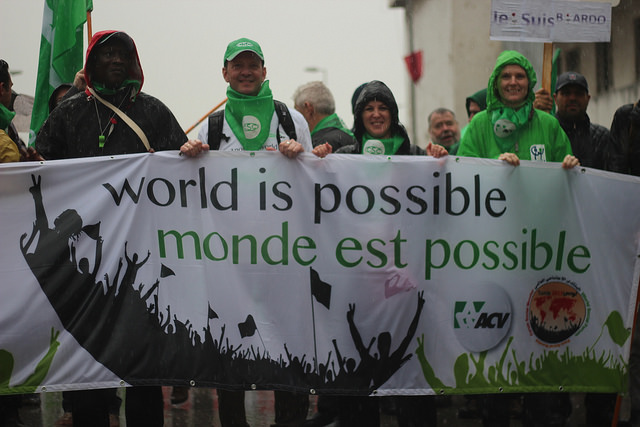
By Ashish Kothari If sheer enthusiasm can deliver ‘another world’, the opening rally of the World Social Forum in Tunis on 24th March held much promise. Thousands of women and men, young and old, vociferous and quiet, a colourful multitude of sloganeering, banner-holding, dancing and singing braved rain and well-below expected temperatures to march from the historic Bab Sadoun to the iconic Ba...