Logo degrowth
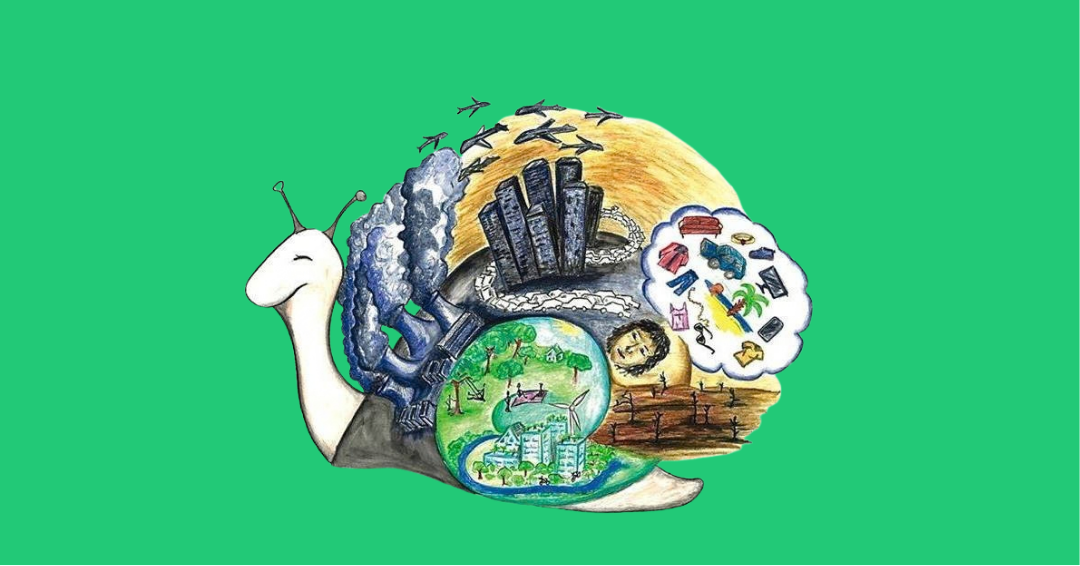
Degrowth snail

Over the past two decades, organisations such as the Support Group for International Degrowth Conferences, the International Degrowth Network (IDN), Degrowth.info and Research & Degrowth have each played a significant role in building the international degrowth movement. Through research, political engagement, communication, networking, grassroots experimentation, international conferences and cooperation, together with all of you, we have collectively contributed to making degrowth a credible and increasingly influential social, political and intellectual project.

 

Today, we believe it is both timely and necessary to come together.


The world is entering an era of profound instability. Escalating wars, accelerating climate disruption, biodiversity collapse, widening inequalities both between regions shaped by colonial and neo-colonial dynamics and within societies themselves, democratic backsliding, the rise of the far right, and the spread of increasingly dystopian techno-solutionist narratives all point towards a systemic collapse. Beyond ecological and economic dimensions, we are also facing deep cultural, anthropological and existential crises.


At the same time, degrowth has never been more relevant.


Public awareness is growing. Recent opinion polls suggest increasing support for many policies associated with a degrowth agenda. Our movement has developed a rich body of research, concrete policy proposals, democratic organisational practices, and numerous practical experiences in territories, municipalities, cooperatives, communities and institutions around the world.


The international dialogue has also deepened. Exchanges between the Global North and the Global South, and between Western, Central and Eastern European perspectives, are enriching degrowth while highlighting the importance of justice, reparations, debt, peace and plural pathways of transformation. Connections with municipalities, political parties, civil society organisations, trade unions, think tanks, practitioners and international institutions—including promising dialogues within the UN system—open new possibilities for collaboration and impact.


Yet despite this momentum, our collective resources remain extremely limited. Our organisations often work in parallel, sometimes duplicating efforts, while facing similar financial and organisational challenges. Strengthening cooperation, solidarity and strategic coordination could considerably increase our collective capacity without compromising the diversity, autonomy and strategic pluralism that are among the movement’s greatest strengths.


The mentioned organisations are therefore meeting for a retreat end of November 2026, conceived as a space for strategic reflection, mutual learning and collective imagination.


Rather than arriving with fixed answers, we invite everyone, through an open questionnaire, to contribute ideas, questions and proposals on how we can reinforce the international degrowth movement in the years ahead.


Possible themes include:

  • Governance, cooperation and synergies: strengthening cooperation between the different nodes of the international degrowth ecosystem while respecting their diversity and autonomy.
  • Welcoming and connecting newcomers: facilitating meaningful participation and creating pathways for newcomers to find their place, connect with others and contribute to strengthening the international degrowth movement.
  • Collective capacities and movement education: developing collective capacities through transformative learning, facilitation, strategy development, conflict navigation and other forms of movement education, while sharing good practices, experiences and resources.
  • Strategic alliances and articulation: building alliances and modes of articulation with social movements, municipalities, NGOs, political actors at different scales, researchers, practitioners and other potential allies.
  • Solidarity-based funding and shared resources: developing creative funding models and shared commons inspired by mutualism, cooperativism, open-source communities and the commons movement.
  • Knowledge commons and collaborative infrastructures: developing shared knowledge, open resources and collaborative infrastructures that reduce duplication and strengthen collective learning.
  • Communication and experimentation: improving communication within the movement and increasing the visibility and accessibility of degrowth beyond our existing circles, while fostering experimentation with new forms of organising.
  • Degrowth voices in public and political debates: strengthening our collective capacity to respond to rapidly evolving political situations with thoughtful, plural and timely public voices. How can we identify a limited number of shared strategic priorities while preserving diversity, autonomy and experimentation?
  • International Degrowth Conferences and the next four years: coordinating around the upcoming International Degrowth Conference in Cork, satellite events in Portugal and Romania, and further initiatives emerging through the IDN Event Call, while discussing possible follow-up processes and milestones for the coming four years.
  • From degrowth research and practice to political proposals: strengthening our capacities to support processes leading to political proposals and policy programmes aligned with degrowth at different territorial scales. This could build on initiatives such as the UN work on Eradicating Poverty Beyond Growth, ongoing large-scale research projects, and political platforms developed around the Beyond Growth conferences in parliaments.
  • Strengthening the International Degrowth Network: expanding participation in and strengthening IDN, including more equitable participation and shared leadership across regions, particularly through deeper collaboration with Global South organisations and anti-colonial perspectives.
  • Emerging priorities: identifying other issues, opportunities and priorities that deserve collective attention.


Our ambition is modest but important: to leave this gathering with stronger relationships, clearer priorities, practical commitments and renewed energy for advancing degrowth as a diverse, democratic and transformative international movement.


Support Group for International Degrowth Conferences, the International Degrowth Network (IDN), Degrowth.info and Research & Degrowth

About the authors

The Support Group of the International Degrowth Conferences


A collective constituted by representatives of former degrowth conference organising committees. As of 2025: François Schneider (Paris), Brototi Roy and Federico Demaria (Barcelona), Jean-Louis Aillon, Silvio Cristiano, Mario Sassi, Michel Cardito (Venice), Gualter Baptista (Leipzig), Vincent Liegey, Alexandra Koves (Budapest), Ekaterina Chertkovskaya (Malmö), Mark Burton (Manchester), Mladen Domazet (Zagreb), Cristina Vázquez Santos, Mario Pansera, Brais Suárez Eiroa (Pontevedra), Elisabeth Veivåg Helseth, Erik Gomez-Baggethun (Oslo).

More from this author

Research & Degrowth

A think-and-act-tank dedicated to the radical transformation of our economies and societies through research, advocacy, education, training and events around degrowth.

More from this author

The degrowth.info editorial team

We are an international political collective that runs the independent media platform degrowth.info. We create and share accessible content which communicates the diversity of degrowth and related struggles for radical transformation. We strive to put degrowth into practice through developing an internal horizontal governance model. Our collective political voice nurtures the conditions for a just social-ecological transformation. 

More from this author

International Degrowth Network

The International Degrowth Network (IDN) is a global community of individuals, organisations, and degrowth allies committed to creating an equitable and sustainable world for all generations. They build connections across borders while providing a collaborative space to develop alternative pathways toward a better future.

More from this author

Share on the corporate technosphere


Our republication policy

Support us

Strategy

Let’s move on from Erik Olin Wright’s modes of transformation

Mark konig ecgv8s2ipg0 unsplash

By: Charles Stevenson

Building on previous strategy debates on degrowth.info, Charles Stevenson argues for degrowthers moving beyond Erik Olin Wright's typology

Strategy

Cloud capital, degrowth, and strategy for the polycrisis: a conversation with Yanis Varoufakis

Kuppel

By: Charles Stevenson

On July 5, 2015, at the height of the eurozone debt crisis, the Greek demos voted by a wide margin to turn down the bailout offered to them by their Troika of creditors – the International Monetary Fund, the European Central Bank, and the European Commission. At the time, the Greek Finance Minister was Yanis Varoufakis, who had the opportunity to confront the Troika, and to put an end to the endless cycles of rising Greek debt.

Strategy

Degrowth & Strategy is released!

Screen shot 2022 07 27 at 6.37.33 am

By: the Degrowth & Strategy editorial team

In a previous article you may have read about the book Degrowth & Strategy; it was still a work in progress then and we were reaching out for financial support. Today, July 27th 2022, the collected volume Degrowth & Strategy: how to bring about social-ecological transformation is finally out! It may be downloaded and read for free on the publisher’s website, and an affordable paperback ...