
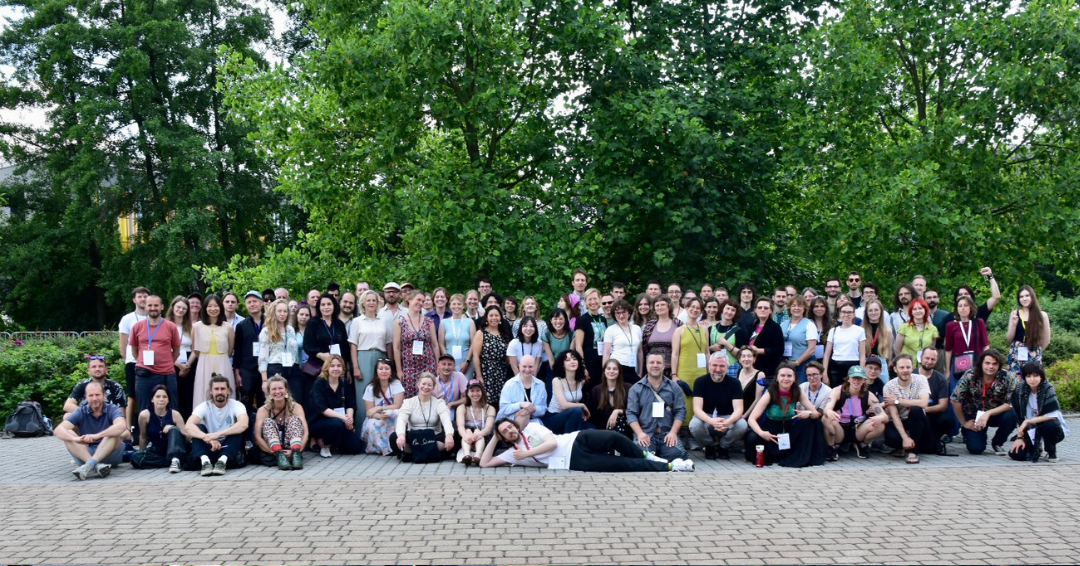
Ten years after the 2016 Budapest International Degrowth Conference and three years after the 2023 Zagreb International Degrowth Conference, a Central and Eastern European Degrowth Conference was held in Kraków in June. It was much more than a regional gathering. It offered a unique opportunity to reflect on a question that remains largely overlooked within the degrowth movement itself: what place is given to Central and Eastern Europe (CEE) in degrowth debates, and what might degrowth learn from the region?
This question was at the heart of a plenary session entitled "Decolonising Degrowth? Challenging Western Epistemic Dominance through Central and Eastern European Perspectives." The session received an enthusiastic response and brought together several contributors to the Routledge Handbook of Degrowth to discuss the intellectual, political and cultural contributions of CEE to degrowth.
When Anitra Nelson and I started editing the Routledge Handbook of Degrowth, we quickly noticed something strange.
If one reads the dominant degrowth literature, one could easily conclude that degrowth was invented somewhere between Paris, Barcelona and a handful of Western European universities.
Meanwhile, Central and Eastern Europe often appears as a footnote, a case study, or occasionally as a region expected to "catch up" with debates taking place elsewhere.
The organisers of the Kraków conference were partly motivated by this very observation. Looking at keynote speakers and flagship events of the international degrowth movement—from conferences to European Parliament events—they noticed how few voices from Central and Eastern Europe were represented. The situation had improved somewhat over the years, but the imbalance remained striking.
This is ironic.
Some of the deepest intellectual roots of degrowth come from this region.
Nicholas Georgescu-Roegen was Romanian. Karl Polanyi grew up in Budapest. Ivan Illich emerged from the intellectual and cultural landscape of Mitteleuropa. Even Rosa Luxemburg, born in Poland, anticipated key concerns of today's degrowth movement through her critique of endless accumulation, imperialism and colonial expansion.
In many ways, Central and Eastern Europe is not a newcomer to degrowth. It helped shape some of its foundational ideas.
This matters because degrowth has always been deeply connected to post-development thinking. In many respects, post-development constitutes one of the intellectual foundations of degrowth.
One of its central insights is that there is no single path to prosperity or good life. The challenge is not simply to "develop better", but to question the very assumptions embedded in the concept of development itself and its imperialistic nature.
Development has often functioned as a universalising project that presents Western trajectories of modernisation as the model for everyone else. Post-development scholars have shown how this framework can reproduce forms of cultural domination, dependency and intellectual colonisation.
This question is particularly meaningful in Central and Eastern Europe.
For more than three decades, the region has often been viewed through a developmental lens: not as a place producing ideas, but as a delayed region expected to converge, imitate, learn and catch up.
We are fully aware that decolonisation cannot be reduced to European debates. The colonial histories and contemporary realities of the Global South remain central to both post-development and degrowth. Yet taking these histories seriously also invites us to examine other forms of epistemic and developmental domination. Central and Eastern Europe occupies a particular position as a European « semi-periphery »: neither colonised in the same way as the Global South, nor part of the historical colonial centres. Looking from this position helps reveal how developmentalist imaginaries, unequal exchange and hierarchies of knowledge also operate within Europe itself. Rather than competing with Southern perspectives, this dialogue seeks to complement and strengthen the broader project of decolonising knowledge production.
Yet researchers such as Petr Jehlička have demonstrated how much is lost through this perspective.
The work he championed on food self-provisioning, allotment gardens and what he calls "quiet sustainability" shows that many environmentally sustainable practices survived and even flourished throughout Central and Eastern Europe.
These practices often remained invisible to Western scholars because they did not fit dominant narratives of innovation, environmental activism or green transition.
Too often, practices labelled as backward, informal or residual turned out to be resilient, low-carbon and socially embedded convivial alternatives.
Repairing rather than replacing. Growing food. Sharing resources. Intellectual curiosity and a passion for arts, expression and culture. Reusing materials. Informal mutual aid. Everyday sufficiency.
Many of these practices survived in CEE not because people read degrowth books, but because they remained part of daily life.
The lesson is profound: perhaps sustainability does not always arrive as innovation from the future. Sometimes it survives as memory from the past.
The issue is not only cultural or epistemic.
Several speakers highlighted how Central and Eastern Europe has been integrated into the European economy through unequal relationships involving foreign ownership, profit repatriation, dependent industrialisation, brain drain and the large-scale export of skilled labour.
Millions of workers, nurses, doctors, engineers and craftspeople well-trained in the East have contributed to the prosperity of Western Europe.
At the same time, many sectors of the region's economies remain dependent on foreign capital and external decision-making centres.
Even consumers have experienced forms of symbolic hierarchy through the infamous "dual-quality" products sold by multinational corporations, where products marketed under identical brands often differed in quality between East and West.
Yet degrowth debates cannot ignore these asymmetries if they wish to engage seriously with questions of justice, autonomy and the decolonisation of knowledge production.
The broader message emerging from the discussion was clear.
Central and Eastern Europe has long been overlooked, misunderstood and treated as Europe's periphery. Yet it also carries a remarkable wealth of experiences, practices and intellectual traditions that can enrich and reshape both degrowth and broader debates on the decolonisation of knowledge.
The objective is not to replace one hierarchy with another. Nor is it to romanticise socialism, authoritarian regime, poverty or scarcity.
Rather, it is to recognise that the region possesses transformation experiences, practices and intellectual traditions that can enrich and transform degrowth itself.
Central and Eastern Europe is not a latecomer to degrowth. It is one of its intellectual birthplaces.
What has often been peripheral is not the region itself, but its recognition and somewhat patronizing treatment within dominant Western academic narratives and political perspectives.
If degrowth seeks to challenge colonial imaginaries globally, it must also be capable of recognising and confronting the hierarchies that continue to shape knowledge production within Europe itself.
The Kraków conference was an important step in that direction.
Hopefully, it will not be the last.
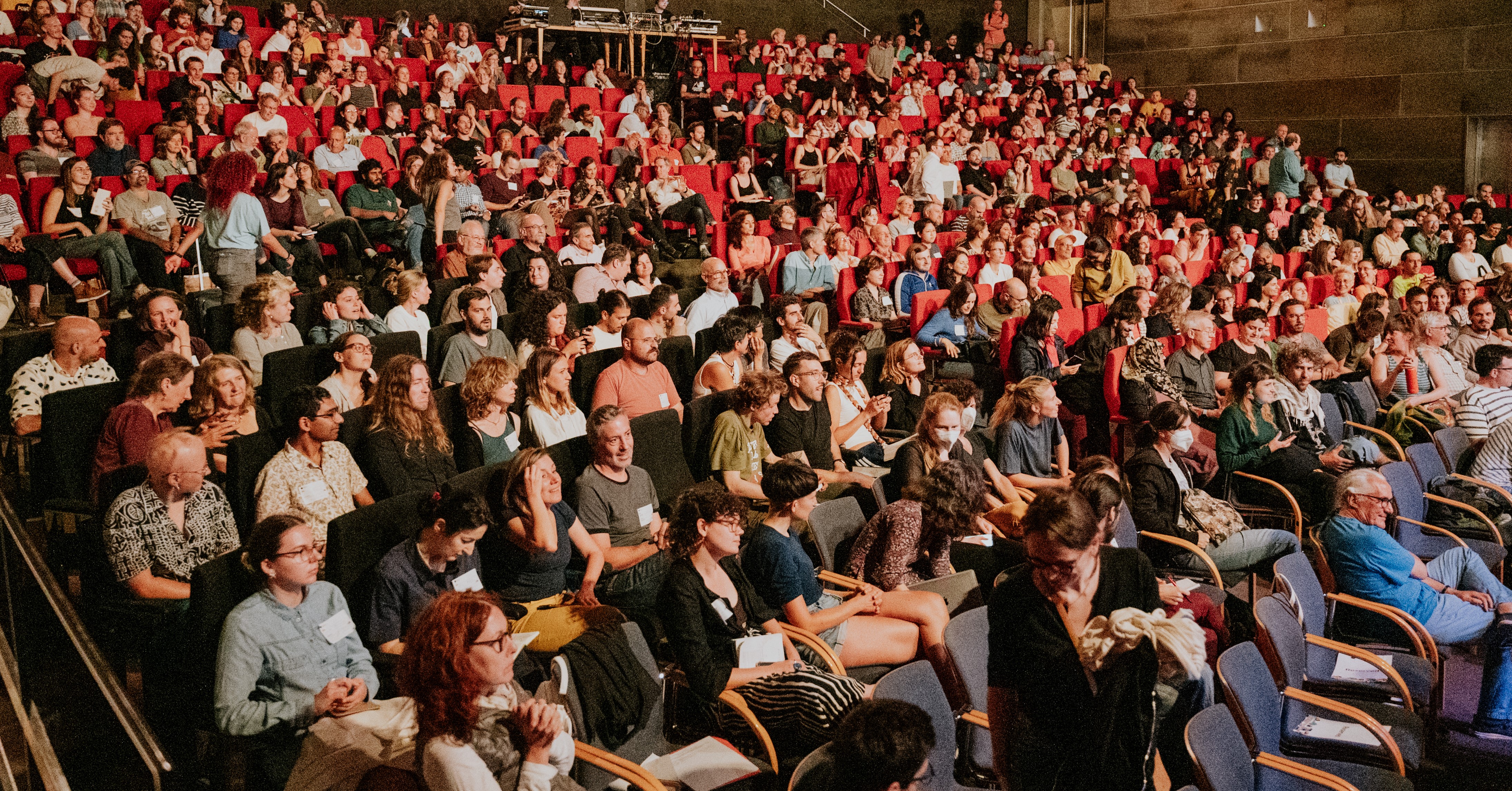
2024 came with a fruitful series of degrowth conferences and festivals. In this article the Support Group offers a retrospective.
Alt+Shift is a combination of keys that allows us to open up a window of possibilities from the few keys that we are given in our keyboard. We need new tools and a new narrative, that must be altogether altering, alternative and altruistic.
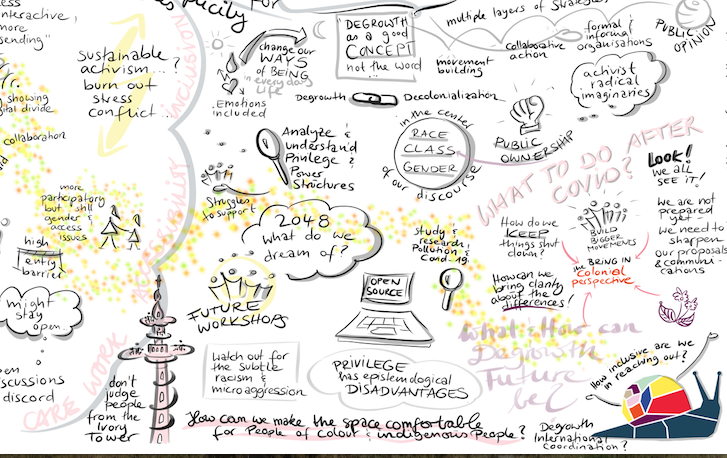
This is part two of a piece reflecting on the Vienna degrowth conference and considering how to move forward based on the inputs and insights from the conference. You can read part one (focused on the conference) here. The idea of organizing the Degrowth Vienna 2020 conference was at least in part connected to a piece that some conference organizers published in this blog in which they crit...