
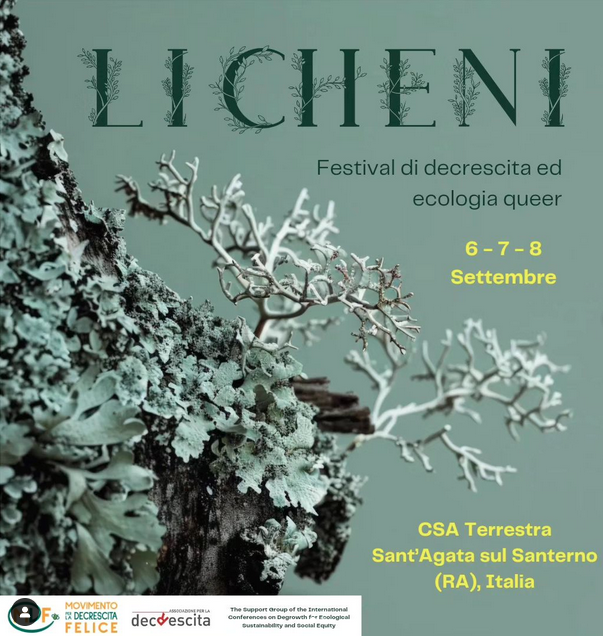
This year is 1st edition of the Licheni Festival, the first in Italy to talk about queer ecology and degrowth! The festival will take place in Sant'Agata sul Terno, about 45 minutes from Bologna. Our host site is a unique and exemplary CSA in Italy, with a queer and anti-speciesist soul; it is called Terrestra and is easily reached with a car or from Lugo station with a walk or cycle along the Romagna's plain. The festival will take place from Friday to Sunday of September 6/7/8. We will post a detailed program later on, but the festival will include debates, creative workshops, philosophical grapepicking, live music and DJ sets, connections and lots of conviviality!
The festival is free, with a volunteer contribution at the door. Exclusively vegan meals will be payed separately with a symbolic price. Overnight accommodation will be in tents on the Terrestra grounds and each night will be charged 5 euros per person as a contribution to the CSA.
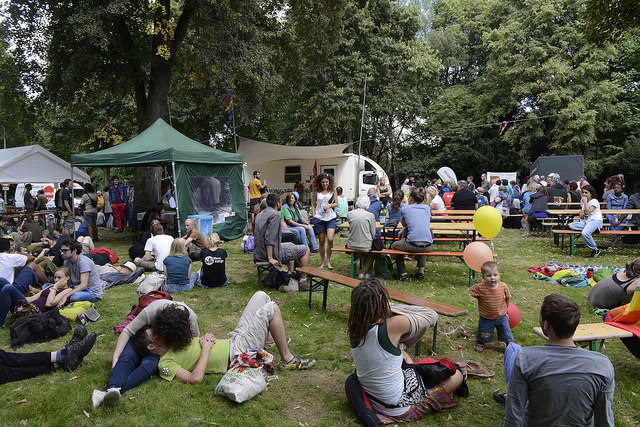
Impressions from the degrowth summer school and the Rhineland climate camp It's now for the second time that the Degrowth Summer School took place at the climate camp in the coal-mining region of the German Rhineland with around 800-900 participants. Last year it had mainly focused on the topic of climate justice and on bringing the two movements – degrowth and climate justice – together. This...
How to sell degrowth is one of the questions of our research and communication project Postwachstumspioniere at the Institute for Ecological Economy Research. In the paper “Successful non-growing companies“, Andrea Liesen, Christian Dietsche and myself are discussing motives and strategies that seem to apply to a variety of non-growing companies. We found that small and medium-sized [...]
On 14 March the last submission period closed for contributions to the conference. After a first quick review it was already clear that all expectations were far exceeded: more than 350 scientific papers were received from a broad range of disciplines such as economics, psychology, geography and urban planning. Further 260 proposals for practice-based activities were submitted by various civil-...