
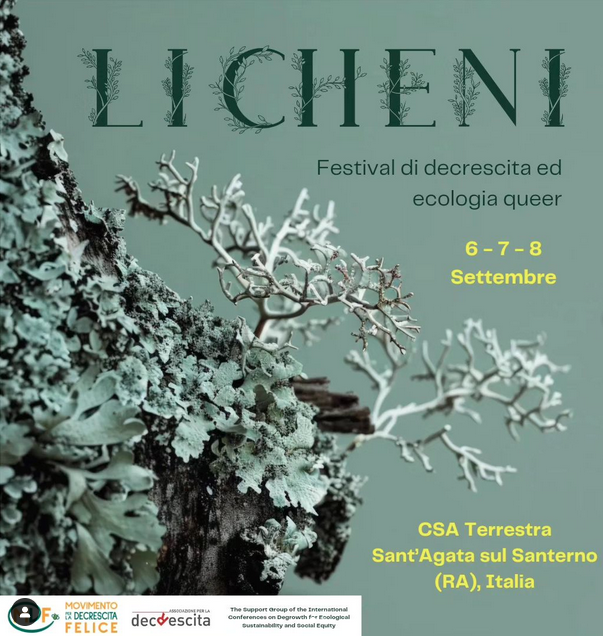
This year is 1st edition of the Licheni Festival, the first in Italy to talk about queer ecology and degrowth! The festival will take place in Sant'Agata sul Terno, about 45 minutes from Bologna. Our host site is a unique and exemplary CSA in Italy, with a queer and anti-speciesist soul; it is called Terrestra and is easily reached with a car or from Lugo station with a walk or cycle along the Romagna's plain. The festival will take place from Friday to Sunday of September 6/7/8. We will post a detailed program later on, but the festival will include debates, creative workshops, philosophical grapepicking, live music and DJ sets, connections and lots of conviviality!
The festival is free, with a volunteer contribution at the door. Exclusively vegan meals will be payed separately with a symbolic price. Overnight accommodation will be in tents on the Terrestra grounds and each night will be charged 5 euros per person as a contribution to the CSA.

Since 2018, a coalition of grassroots environmental groups and progressive politicians in the United States have brought into the public debate the idea of a Green New Deal. The plan is inspired not only by Roosevelt’s New Deal, but also by the subsequent wartime mobilization in response to a large-scale threat. The difference is that this time around the threat is not represented by the Axis p...
The rise of far-right globalization criticism requires a new role for the Degrowth movement. ‘Progressive De-Globalization‘ could be the counter-project that is urgently needed. After the German and Austrian elections, it becomes clear once more that the rise of the new far-right is not a temporary phenomenon. Neither the difficult Brexit negotiations nor the missteps of Donald Trump are sto...
For our project “Degrowth from a future perspective”, we would like to present how Erik Assadourian, Senior Fellow at the World Watch Institute, envisions a Degrowth America in 2100 and looks back to the transiton towards a truly sustainable United States. Will this have become a place where we can still have personal (electric) vehicles, [...]