
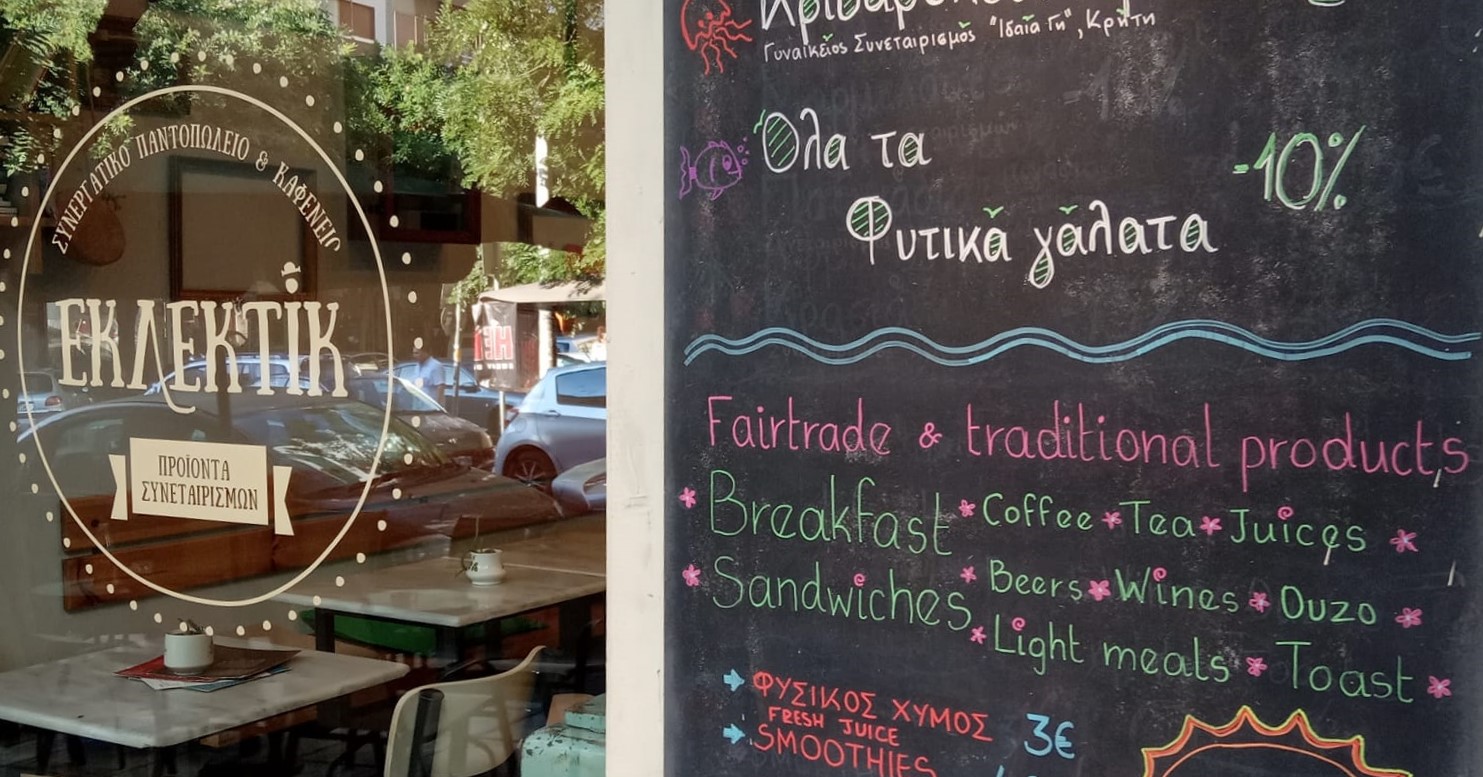
The cooperative grocery store Eklektik. Image source: author.
When people hear the word degrowth, when not problematized or adverted by the rejection of the growth paradigm, they often imagine a future that still needs to be invented. But in many places, parts of that future already exist. In Thessaloniki, Greece’s second-largest city, a wide range of grassroots food networks have emerged over the last fifteen years: cooperative grocery stores like Allos Tropos, BiosCoop, Eklektik, and To Koukouli; cooperatives operating in the food processing sector or the food services industry, like To Oraion Ntepo or Rediviva; markets without middlemen like the one in Kalamaria; solidarity kitchens, such as Room 39, peri-urban gardening projects (for example Per.Ka.) and seed banks, like the local group of the Peliti network. These initiatives have been shaped by the Greek debt crisis and the related austerity, unemployment, social crisis and distrust in dominant institutions. But they also offer something more than emergency responses. They show what food systems can look like when organized around care, democracy and sufficiency rather than profit and endless growth.
Across Europe, especially during the last years, food has become more expensive, more unequal and more dependent on fragile global supply chains. At the same time, industrial agriculture drives biodiversity loss, soil degradation, high energy use and greenhouse gas emissions. On the other side of the food supply chain, supermarkets promise convenience, but they often hide the social and ecological costs of cheap food.
Degrowth asks a simple but radical question: what if food systems were designed not to maximize sales and accumulation, but to meet needs fairly within ecological limits?
Alternative food networks in Thessaloniki offer some practical answers.
One of the clearest lessons from local initiatives is that food does not have to be treated only as something to buy and sell. In solidarity kitchens, surplus food that would otherwise be wasted is transformed into meals for homeless people, migrants and others in need. In cooperative groceries, members organize food donations, solidarity baskets and mutual aid systems. Small producers share unsold produce directly with activist spaces or vulnerable households. These practices matter because they challenge a core logic of the dominant food economy: that access depends only on purchasing power. They also reveal an important degrowth principle. Reducing waste and redistributing resources can improve social justice and lower ecological pressure at the same time.
Many participants in Thessaloniki’s initiatives describe something often missing in conventional retail and food chains: meaningful work. Instead of rigid hierarchies, cooperatives use assemblies, collective decisions and shared responsibilities. Worker-members often report stronger relationships, more autonomy and a sense that their labour serves a social purpose.
This is important from a degrowth perspective, since degrowth is not just about producing less. It is also about transforming the meaning and organization of work. But we should be careful with romanticizing these initiatives. Many face chronic financial pressure to the point that they cease operations; hard and digital infrastructure tends to be limited, paid staff may receive modest incomes, volunteers can become overburdened and burnout is a real risk. Grassroots alternatives struggle everyday to carry the burden of transformation while operating inside an economy still structured around competition and accumulation.
Apart from elections or parliaments, democracy, as degrowth among other movements has insisted, also happens in everyday life: who decides, whose voice matters, who controls resources, whose knowledge counts. Grassroots food networks often create small but meaningful spaces of democratic practice. Members debate prices, sourcing, wages and priorities. Consumers meet producers directly at market or at fiestas. Knowledge about farming, nutrition and cooperation is shared horizontally rather than imposed from above. This does not mean power inequalities disappear. Participation can still be uneven. Some people have more time, confidence or expertise than others, but these spaces matter because they allow people to practice democracy, not just talk about it.
Alternative food networks are often criticized for serving mainly educated and middle-class consumers. Sometimes that critique is justified. Yet the picture in Thessaloniki is more complex. Some initiatives, such as markets without middlemen or peri-urban gardening, have attracted and still attract, to a large extent, also low-income households. Some deliberately try to reduce barriers through material and knowledge support, affordable prices, donations or flexible participation models. Still, inclusion does not happen automatically. Cost, time, cultural norms, childcare, transport and confidence all shape who can participate. This is a key lesson for the wider degrowth movement: alternatives are not enough if they remain socially narrow. Social justice must be built intentionally.
Too often, governments praise “community resilience” while leaving communities underfunded. If policymakers are serious about food sustainability, they should support alternative food networks instead of treating them as marginal experiments.
That could include:
The point is not to replace every supermarket tomorrow. It is to expand the ecosystem of food systems that already work differently.
Thessaloniki’s alternative food networks are imperfect, partial and often fragile. They face contradictions every day: affordability versus fair wages, volunteer energy versus exhaustion, ethics versus survival. But that is precisely why they matter. They remind us that transformation does not begin with a perfect blueprint. It begins with experiments, tensions, collective learning and institutions built from below. Degrowth is sometimes dismissed as unrealistic because it challenges dominant economic common sense. Yet in solidarity kitchens, cooperative grocery stores and shared gardens, people are already practicing pieces of it. Not necessarily as ideology or only as ideology, but also as everyday life that sets the foundations of a different food future.
This article draws on research that Eirini-Erifyli conducted as part of her PhD dissertation and on some of the findings presented in this article.
degrowth.info speaks to small-scale farmer Jean Thévenot about EU farming and La Via Campesina's work at the international level.
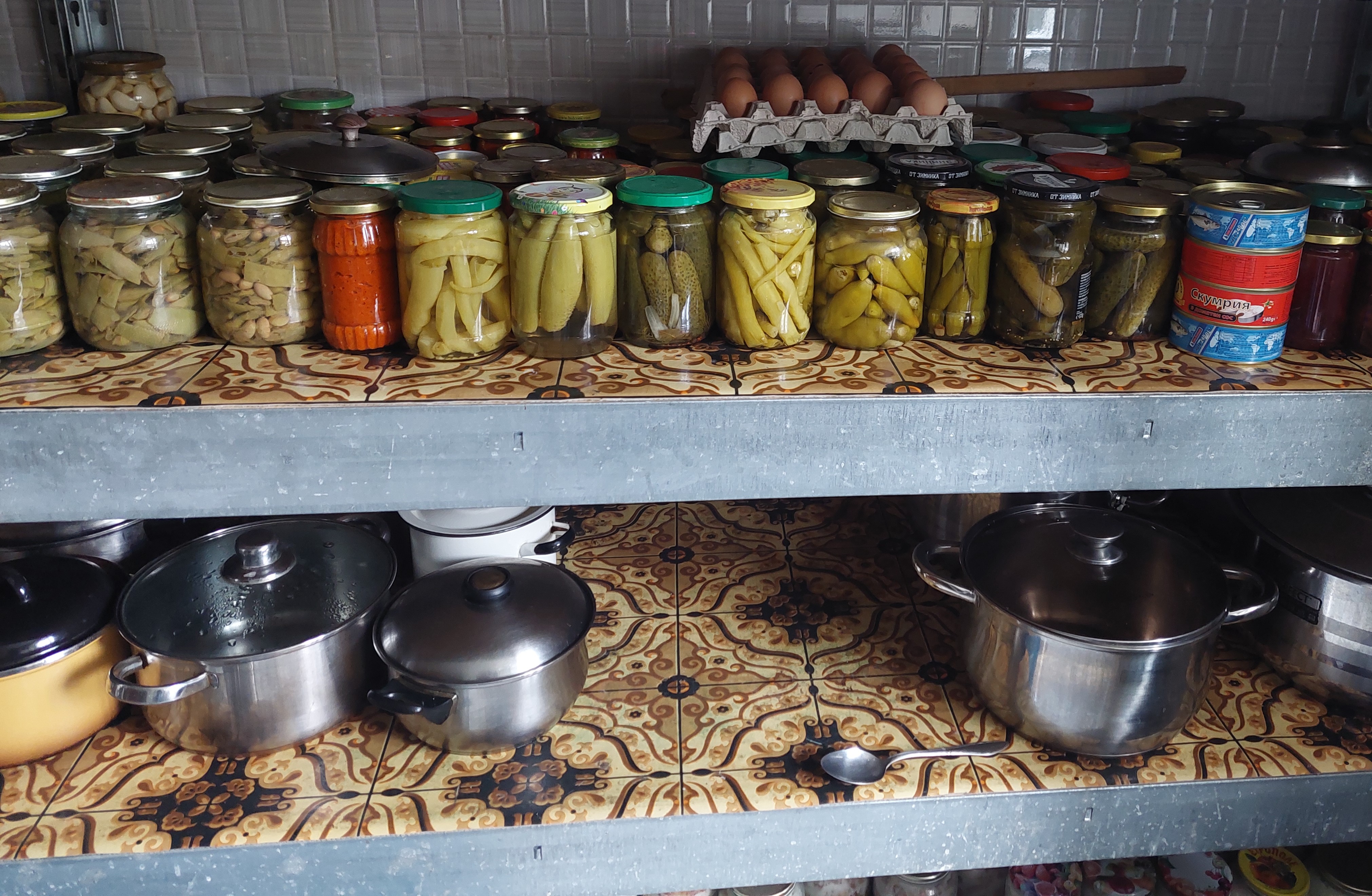
Crusty Bread, creamy cheese, bubbly kimchi or refreshing tepache – all cultures have fermented foods and beverages with their own traditions, language, and cultural heritage surrounding them. Fermentation, in this sense, is a living food culture that taps into ancient skills and traditional knowledge. But this knowledge is under attack. As capitalism continues its onslaught on rural, indigenous...
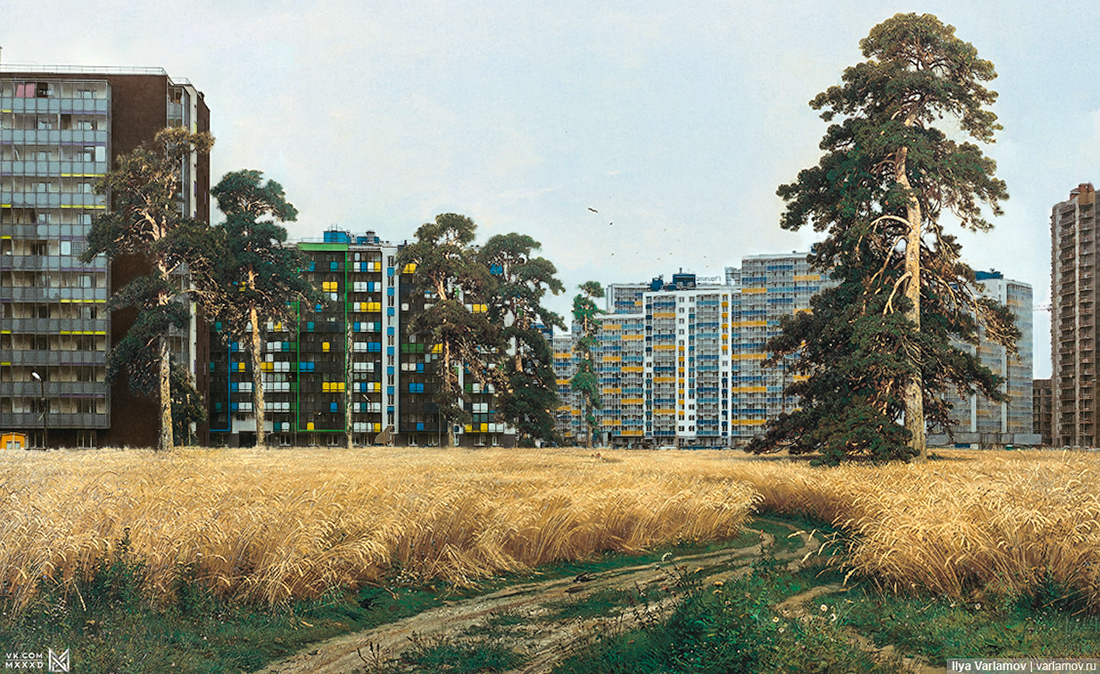
Perspectives from Eastern Europe and particularly Russia are so far underrepresented in degrowth debates. Translated from its original Russian, the piece below showcases an interview with a prominent British-Russian academic, Teodor Shanin, discussing degrowth in the Russian context through the lens of agriculture. Accordingly, it enables new audiences to gain an insight into this underrepresen...