
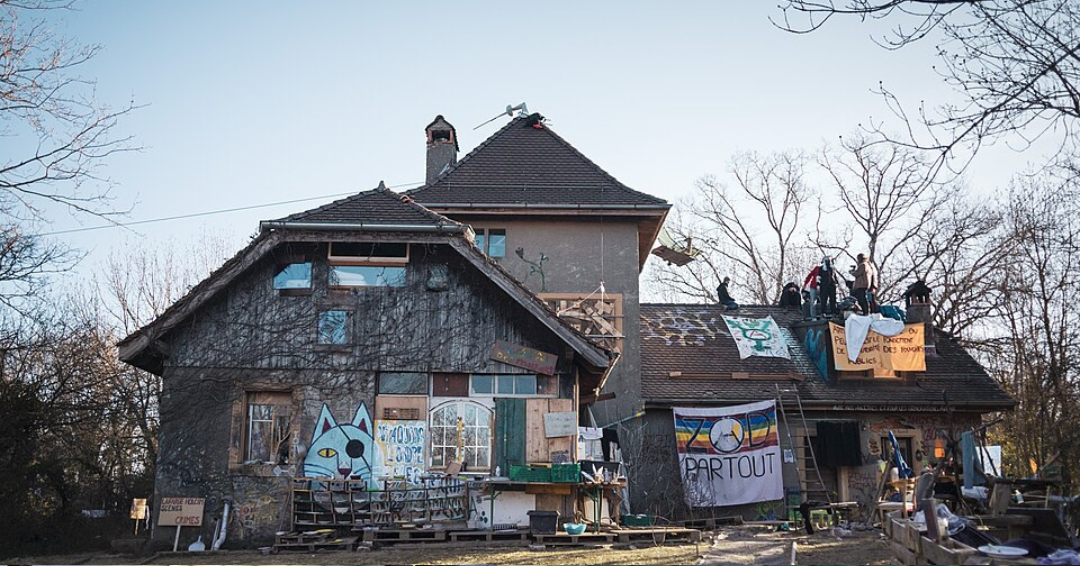
Anarchist Zone to Defend. Credit: Lahminewski Lab, CC BY 4.0.
As Jason Hickel acknowledged in a recent article on degrowth.info, the anarchist orientation has been “predominant” within degrowth for a long time. What we understand today as degrowth emerged in the early 2000s, at the height of the anarchist revival in social movements. The Frenchman who organised under the banner ‘décroissance’, Vincent Cheynet, had just launched the French version of the anarchist magazine Adbusters. The anarchist-leaning alter-globalisation movement was in full swing, and décroissance was part of it.
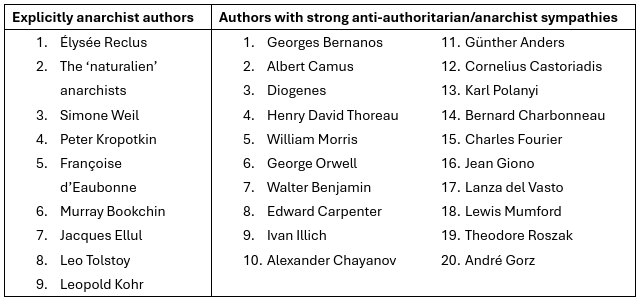
The early French degrowth movement had strong affinities with anarchism. Some pleaded for ‘libertarian degrowth’, and most of its intellectual inspirations were either explicitly anarchist or had strong anti-authoritarian and often anarchist sympathies. Out of the 38 authors in the Précurseur·ses de la décroissance [degrowth precursors] book series, I identified 29 falling into this category.
Positions of authors in the "degrowth precursors" series
French degrowth spheres still contain anarchist tendencies. The bi-monthly newspaper La Décroissance is its most influential representative. Launched in 2004 and still issued at 30,000 copies today, it explicitly positions itself against “ecocracy”, “techno-bureaucratic administration that manages rationing” and even “authoritarian degrowth”. The title of its May-June 2025 issue was “Non-power will save the world”, in reference to Jacques Ellul’s anarchist concept of ‘non-power’. In the July-August 2025 issue, Serge Latouche wrote:
“For us as for Ellul, the unmissable precursor of degrowth, the ecologist current (and the same goes for degrowth) ‘should develop as a form of counter-power, without entering the politician game’. It is not about conquering the state apparatus, in the style of Lenin in 1917, but about constituting a force of whistleblowers, resistance and proposals”. [own translation]
Even if the most important figure in the early expansion of degrowth to the English-speaking world was the “moderate anarchist” Joan Martínez-Alier, anarchism is marginalised in today’s international degrowth spheres. For instance, Jason Hickel, who is arguably the most influential degrowther in current times, has recently said that anarchist tactics are “not at all adequate to the material reality we face”. In the recent special issue on anarchy and degrowth in the Degrowth Journal, Dunlap and Becker claim that “anarchist political positions [are] either ignored, confused, or marginally engaged with, by degrowth”. They argue that anarchism is “akin to a ‘guilty pleasure’ within the majority of degrowth policy proposals that tend to emphasize top-down approaches”.
Based on his review of the degrowth literature, Fitzpatrick claimed that the state – and, implicitly, the extremely large means of coercion, violence and surveillance of the police, military, prisons and secret services – is taken “for granted as a fundamental prerequisite”. Moreover, its repressive apparatus is rarely criticised, even as the abolitionist current has gained popularity in recent years.
Frequently, degrowthers fall into the trap of caricaturing anarchists as solely engaged in lifestyle simplicity and eco-communities removed from today’s struggles. While such tendencies might exist, insurrectionary and confrontational tactics are central to anarchism. Recent examples include the eco-anarchist NoTav, ZAD, Stop Cop City and Hambach Forest occupation movements as well as many revolutionary or rebellious movements in the Global South, such as the Zapatistas and Rojava, that are close to anarchism.
At this stage, one might wonder why anarchism would have become marginal in international degrowth spheres. In my view, multiple factors are at play, but the most important is the hegemony of academia.
It is common knowledge among anarchists that academia is not a safe place for their ideas. The late David Graeber argued that, while anarchism was “going through a veritable renaissance” in the 2000s, “most academics seem to have only the vaguest idea any of this is happening, and tend to still be at the stage of dismissing [anarchism] with stupid jokes […] if, indeed, they are even aware of its existence”. He said that “there are still thousands of academic Marxists and no more than three or four well known academic anarchists”.
For Graeber, this was not a coincidence. He viewed academia as a feudal system full of the hierarchies that anarchists fight against. In order to reproduce itself over time, academia creates “functionaries who when they finally do have tenure, and can say whatever they want, are almost certain not to have anything too dramatic or relevant to say”. Those who want to deeply and frontally question hierarchical structures such those of academia “are kicked out or marginalized”.
While degrowth was in its early years dominated by activism and practice, it has become a “highly academic community” in which recognition is gained through academic credentials. Given the tendency of academic structures to oppose anarchism, it is not surprising that it has fallen out of fashion in degrowth.
The increasing marginalisation of anarchism is, I believe, a mistake. Not really because it leads to historical amnesia and reduces diversity, but because degrowth would benefit from taking anarchist principles and tactics seriously.
Anarchism is an important – but crucially underestimated – force in today’s world. In the last decades, anarchists were behind the alter-globalisation and Occupy movements. Other recent social movements, such as Black Lives Matter, the Zapatistas, Rojava and the Arab Spring, clearly followed anarchist tactics even without calling themselves ‘anarchists’. In January 2026 alone, anarchist principles and ideas have fuelled major events in Minneapolis, Syria and Iran. Some have argued that anarchism has been the most influential revolutionary movement since the fall of the Berlin Wall. It is also worth stressing that historians (even the Marxist Eric Hobsbawm) agree that, until 1917, anarchism was the “dominant element in the self-consciously internationalist radical Left”.
Although anarchism has not (yet) radically changed the world, I agree with David Graeber that anarchists have won important social battles. For instance, the alter-globalisation movement has considerably damaged the neoliberal ‘Washington Consensus’ around the WTO, the IMF and the World Bank. The 1970s anti-nuclear movement has significantly halted the construction of nuclear plants, and the anarchist-leaning 1968’s New Left has been instrumental in reducing oppression against women, black and gay people.
I do not have the space to detail the distinct tactics and principles adopted by anarchists. Let me just mention what I see as its essence; in the words of Grubacic and Graeber: “the rejection of any idea that the end justifies the means, let alone that the business of a revolutionary is to seize state power and then begin imposing one’s vision at the point of a gun”.
Anarchists do not reject such tactics (just) for ethical reasons. They believe that systematically relying on large means of domination – violence, propaganda, surveillance and manipulation – will never lead towards a desirable future. This is because anarchists think that domination tends to create more rather than less domination. They resonate with the popular adage that power corrupts. As Bakunin famously said: “If you took the most ardent revolutionary, vested him in absolute power, within a year he would be worse than the Tsar himself”.
Most anarchists acknowledge that coercion, hierarchies and policy reforms (which, crucially, are implemented through coercion) have a role to play. However, because these means tend to recreate systems of domination, anarchists make active efforts to use them cautiously, to a limited extent and only in specific circumstances. For example, they might rely on them to defend the most oppressed or an already ‘liberated’ territory.
Anarchists fight against so-called Leninist tactics, which broadly consists in building a party that takes over the state apparatus through disciplined actions in order to instil a centralised ‘dictatorship of the proletariat’ that ‘educates’ the masses. These ideas, when implemented by Lenin and Trotsky, led to an extremely repressive dictatorship soon after the 1917 Russian revolution. According to the historian James Ryan, conservative estimates suggest “28,000 executions (excluding battlefield deaths) on average per year directly attributed to the Soviet State” during Lenin’s reign until 1922. As a result, anarchists view Leninism as authoritarian.
Leninism has gained traction within degrowth spheres in recent years. To illustrate, some explicitly Leninist intellectuals and groups – such as Andreas Malm, Kai Heron and Climate Vanguard – are popular. Some degrowth academics also open the door for such ideas, or at least for the reliance on large means of domination, when they argue that “the will to coerce and rule [is a] prerequisite for degrowth” and that “domination is an important and desirable feature of society”. While Hickel has never declared himself in favour of Leninism – even if he has cited Lenin in his work – he also appears to have affinities with them when he advocates for “building mass parties” and to “take power” of the state apparatus. The fact that he recently praised Chinese ‘democracy’, overlooking its extensive repression of dissenting voices and marginalised groups, also indicates sympathies for tactics that involve large means of domination.
I hope to have shown, as Hickel had requested, that anarchists “advance a viable alternative strategy”. If degrowth genuinely aims for radical social change that does not reproduce some patterns of domination that it rejects in principle, it should take anarchism more seriously.
This article is part of a spontaneous series on degrowth and strategy, which was triggered by a strong reaction to a Jason Hickel interview. The series is concerned in particular with the question of the state and party politics.
Find all articles in the series below:

Giorgos Kallis contests recent interventions which lament the current direction of degrowth and its strategies, arguing instead for a community of pluralist yet tense alliances.

In this article Myriam Best analyses the ongoing french movement Earth Uprisings which struggles for land and water commons and the dismantlement of the techno-industrial capitalist complex.

degrowth.info speaks to Climate Vanguard, the UK-based organisation seeking to radicalise the youth climate movement around ecosocialism.