
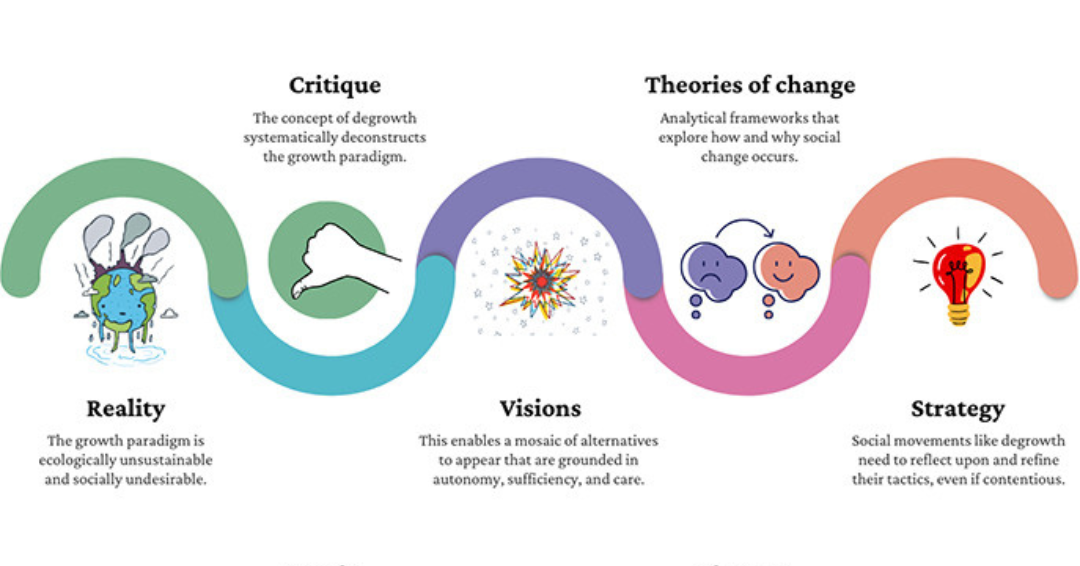
Source: Fitzpatrick et al. 2025. Visual: Sara Al-Mahdi & Nick Fitzpatrick.
How do people conceptualise degrowth? What are the strategic implications of different theories of social change? And what direct action tactics do degrowth advocates support? These are the questions we sought to answer in our recent article in Energy Research & Social Science, Exploring the degrowth movement: A survey of conceptualisations, strategy, and tactics with Matthias Schmelzer and Dennis Eversberg.
The degrowth movement did not emerge from abstract theorising but from decades of resisting Western so-called development projects in the periphery of the capitalist world economy. Originating in the 1970s as a radical critique of “sustainable development”, degrowth was first articulated by French anti-advertising activists who reclaimed the term “décroissance” as a political slogan. The term quickly spread throughout Italy, Catalonia, Spain, México, Belgium, Québec, Switzerland, and Germany as a banner under which people practised prefigurative politics and direct action. Since 2008, when “décroissance” was translated into English as “degrowth”, with the aim of increasing scientific legitimacy and social impact, parts of the degrowth movement have been drawn back to the mainstream orthodox economic thinking that the movement sought to reject in the first place (e.g., apolitical analysis, economic modelling). In our latest article, we sought to investigate these internal tensions on how best to approach strategy and tactics to achieve collective liberation.
Contemporary research on degrowth has increasingly centred around how to translate theoretical academic critique into concrete political actions. Following the translation of décroissance into degrowth, early interventions explored diverse strategies such as state policies, nonmonetary markets, and bank robbery. This included an early adoption of the strategic logics of self-proclaimed democratic market socialist, Erik-Olin Wright. Whereas Wright articulated three political traditions – social democracy, anarchist communism, and revolutionary socialism – that corresponded to three transformative logics – symbiotic, interstitial, and ruptural – degrowth scholars proposed three similar strategies for achieving degrowth: policy reformism, building alternatives, and oppositional activism. Categories that have since been re-labelled as non-reformist reforms, experimental nowtopias, and building counter-hegemony in The Future is Degrowth and as a “strategic canvas” that seeks to both reduce harm and transcend structures in Degrowth & Strategy. Recently, this has led people to discuss how to move beyond Erik-Olin Wright, how to avoid conflating degrowth with ecosocialism, degrowth politics and strategy, and how to delink by pairing Northern degrowth with Southern sovereignty.
This is because political strategies are fundamentally intertwined with political ideologies: conceptual frameworks that provide the foundation for organised political action aimed at preserving, modifying, or overthrowing existing power structures. Broadly speaking, political ideologies contain three key components: (1) a critique of the existing social order, (2) a vision of potential future societal configurations, and (3) a theory of social change. This theoretical diversity is evident in the rich heterodox tapestry of the degrowth movement that encompasses people with ideologies like anarchism, communism, environmentalism, feminism, liberalism, Marxism, socialism, and third-worldism. However, it is important to understand how different political ideologies are underpinned by different critiques of growth, visions for degrowth, and theories of social change. This is why our article investigated how people conceptualise degrowth and its relationship to theories of social change through a pre-selected inventory of direct-action tactics.
To capture the strategic diversity within the degrowth movement, a survey was developed through an iterative process with several activist groups within the International Degrowth Network. The questionnaire was designed around 45 strategic statements, refined from a systematic mapping of degrowth literature and an inventory of direct-action tactics.
The survey was distributed through two primary channels to ensure a representative sample of scholar-activists. First, it was offered to all 400 attendees of the 9th International Degrowth Conference in Zagreb in August 2023. Second, it was emailed to 823 corresponding authors of degrowth publications from 2005 to 2023. From these 1,223 invitations, we received 399 complete responses. The results revealed a movement grappling with its strategic identity, defined by internal diversity, and a surprising consensus on direct action. The data reveals four primary currents, each with a distinct theory of change.
 Antagonistic Anarchists (21 %) are defined by their rejection of state power and hierarchical structures. Their strategy is prefigurative, embracing grassroots direct action to dismantle existing systems by building new ones. This is reflected in their support for confrontational tactics, including sabotage and property destruction.
 Systemic Utopianists (23 %) navigate a dual strategy of working both within and against. They believe in the necessity of capturing state power to implement radical top-down policies like rationing and planning, yet simultaneously maintain strong support for nonviolent resistance and anti-property actions from below.
 Environmental Pragmatists (27 %) advocate for a reformist approach. They conceptualise degrowth through an economic lens that favours state-based reformism and market-based instruments. They show the lowest support for direct action tactics and prefer traditional political channels to achieve post-growth.
 Ecological Limitarianists (29 %) are the central planners. They believe in strict regulations, rationing resources, and state-led planning to ensure equity and sustainability. Their support for disruptive direct action is tempered by an obsession for outlining how degrowth futures will look.
Overall, the survey received 399 responses from participants spanning 54 countries. Most respondents were citizens (94 %) or residents (97 %) of the Global North, with 84 % of people residing in Europe. The top six represented countries by citizenship were Germany (15 %), U.K. (9 %), U.S.A. (8 %), Italy (8 %), Spain (7 %), and France (6 %).
Academic backgrounds were highly interdisciplinary, with 73 disciplines represented. Most respondents hold a postgraduate degree (92 %), primarily in humanities and social sciences (77 %). The top five disciplines were economics (19 %), sociology (8 %), geography (6 %), engineering (6 %), and political science (5 %). While 43 native languages were present, 76 % of respondents spoke one of six languages: English (27 %), German (19 %), Spanish (10 %), French (9 %), Italian (7 %), and Croatian (4 %), with 90 % speaking more than one language, and 62 % speaking three or more.
The majority of respondents identify as male (55 %), especially among academics (64 %). The age of respondents by generation were 52 % Millennials, 24 % Gen X, 12 % Baby Boomers, 10 % Gen Z, and 2 % Silent. This tends to correspond with employment characteristics where 80 % are workers, 11 % are students, and 6 % are retired. At least 85 % earned more than the median European household income (€1780 per month) in 2022.
Overall, 84 % were members of and/or active in an organisation. The most popular types of organisations that respondents were members of include NGOs (40 %), science-activist networks (37 %), workers’ unions (27 %), political parties (23 %), and alternative economy projects (22 %). However, this changes to NGOs (29 %), science-activism (28 %), alternative economy projects (21 %), political parties (8 %), and workers’ unions (6 %) when only considering active engagement.
Overwhelming majorities agree on a core critique: the rich will not redistribute voluntarily (88%), that pricing nature is not the solution (76%), and that Global South nations should not prioritise capitalist growth (71%). This unified front confirms a common diagnosis of economies structured around capital accumulation and monetary markets. The movement’s preanalytic vision is further defined by a rejection of the ideas that humans are naturally selfish or that society must collapse before it evolves. This is backed up by convictions that the personal is political, profit-making is a form of violence, and military spending must be abolished. This sets degrowth apart from mainstream sustainability visions and entails a responsibility for academics to become activists. The challenge is not just to demand degrowth, but to win demands and build people power against fossil capital and power elites, ensuring reductions in production and consumption are guided by principles of decolonisation, decommodification, and demilitarisation.
This shared vision, however, gives way to strategic pluralism, particularly toward the state. The movement is divided between those who see the state as a vehicle to be captured for a top-down transition (Systemic Utopianists) and those who view is as an oppressive structure to be dismantled (Antagonistic Anarchism). This ideological diversity – drawing from anarchism, feminism, and Marxism, as well as eco-modernism, liberalism, and post-Keynesianism – leads to strategic divergence. Another key consideration is the distinction between scientific (methodological) pluralism, which can reproduce methodologies from orthodox economics, and the pluriverse, which advocates for structural transformation by consolidating radical alternatives. The movement must therefore draw conceptual boundaries, building alliances with heterodox alternatives while excluding orthodox economic approaches that are incompatible with its core principles. Here, the clusters of Antagonistic Anachism and Systemic Utopianism represent a potentially unifying force committed to degrowth heterodoxy and active revolutionism, while Environmental Pragmatism often employs mainstream methods under the guise of pluralism.
When it comes to action, the survey reveals a decisive lean towards confrontational, unarmed resistance. While traditional tactics like social movements (93%), labour strikes (88%), boycotts (81%), and demonstrations (73%) are widely supported, the most significant finding is the majority endorsement of “anti-property actions” like occupations (78%), blockades (72%), hacktivism (67%), trespassing (63%), and sabotage (53%). This indicates a movement-wide recognition that achieving degrowth requires actively disrupting the material flows of capitalist structures. Support for these actions remains conditional on not engendering human life, with insurgency tactics like assassination unanimously rejected. Tactically, Antagonistic Anarchists and Systemic Utopianists favour this active, bottom-up resistance, while Environmental Pragmatists and Ecological Limitarianists are more sceptical, preferring symbiotic strategies and traditional reformism. While some see direct action as a necessary tool for dismantling oppressive systems, others worry this could alienate potential allies. This comes despite the ongoing failures of representative democracy in creating a legitimate role for direct action. The critical challenge is how to navigate the balance between tactical effectiveness and strategic ethics, building on the strong support for nonviolent resistance and strategic anti-property actions to form a coherent strategy of unarmed resistance.
The core tension, therefore, is not about the need for resistance, but its ultimate objective and form. The strategic pluralism within the degrowth movement – for example, the debate between harnessing versus abolishing state power or between following or rejecting orthodox economics theory – is its central challenge. Yet our findings reveal a movement overwhelmingly composed of highly educated, materially privileged people from the Global North – a demographic reality that risks reproducing the very structural blind spots degrowth seeks to dismantle.
Hence, the suggestion is that the internal debate on degrowth strategy must not lead to questioning the legitimacy and tactics of resistance movements – including those who take up armed resistance - in the Global South. As British-Iraqi rapper Lowkey poses in the song Hand On Your Gun: “Who says what is and what isn’t legitimate resistance?” Hence, instead of spending time judging the strategic and tactical choices of those actively resisting capitalist imperialism (e.g., Iran, Palestine, Yemen), including those who take up armed resistance, people within the degrowth movement should be asking themselves deeper questions about how they can become genuine allies in the struggle for collective liberation, which includes questioning and moving beyond Eurocentrism and liberalism.
Moving beyond academic articles like the one presented here towards such solidarity necessitates that proponents of degrowth adopt an unequivocally anti-imperialist worldview. This involves opposing US imperialism and EU capitalism, including alliances such as NATO, which are dependent on the concentration of production and capital into monopolies, the merging of financial and industrial capital, and the exporting of capital in addition to commodities. Such a position is necessary because the global structures of capitalism promote unsustainable resource use and unequal social relations that flow from the periphery to the core. This is because there is no doubt that the imperial mode of living cannot be universalised beyond a small group of high-income countries that are dependent on extractivism and exploitation.
This does not mean the degrowth movement should automatically strive to take state power, far from it. For example, when 80% of our respondents fly well above global averages while simultaneously endorsing anti-property actions, it suggests that structural critiques of capitalist imperialism often remain abstract and disconnected from the material conditions that enable both our activism and our inconsistencies. So, what does it all mean? Again, as Lowkey reminds us, “the words of those that are barely ready to speak mean little to those ready to die.” Despite the different strategic preferences within the degrowth movement, one thing is for certain: the degrowth movement needs to learn to struggle with and not on behalf of oppressed peoples worldwide. This necessitates becoming a principled and staunch anti-imperialist movement.
All visuals were created by Sara Al-Mahdi
This article is part of a spontaneous series on degrowth and strategy, which was triggered by a strong reaction to a Jason Hickel interview. The series is concerned in particular with the question of the state and party politics.
Find all articles in the series below:

As a response to Jason Hickel's interview with the Break-Down Journal, the authors share their thoughts on degrowth as a concept and a movement, and the role it plays in a challenging political context.

Militant-scholar, Ana Inés Heras, writes about collaborative projects between her research team at the Argentinean Council and various self-governed local communities and groups.

On July 5, 2015, at the height of the eurozone debt crisis, the Greek demos voted by a wide margin to turn down the bailout offered to them by their Troika of creditors – the International Monetary Fund, the European Central Bank, and the European Commission. At the time, the Greek Finance Minister was Yanis Varoufakis, who had the opportunity to confront the Troika, and to put an end to the endless cycles of rising Greek debt.