

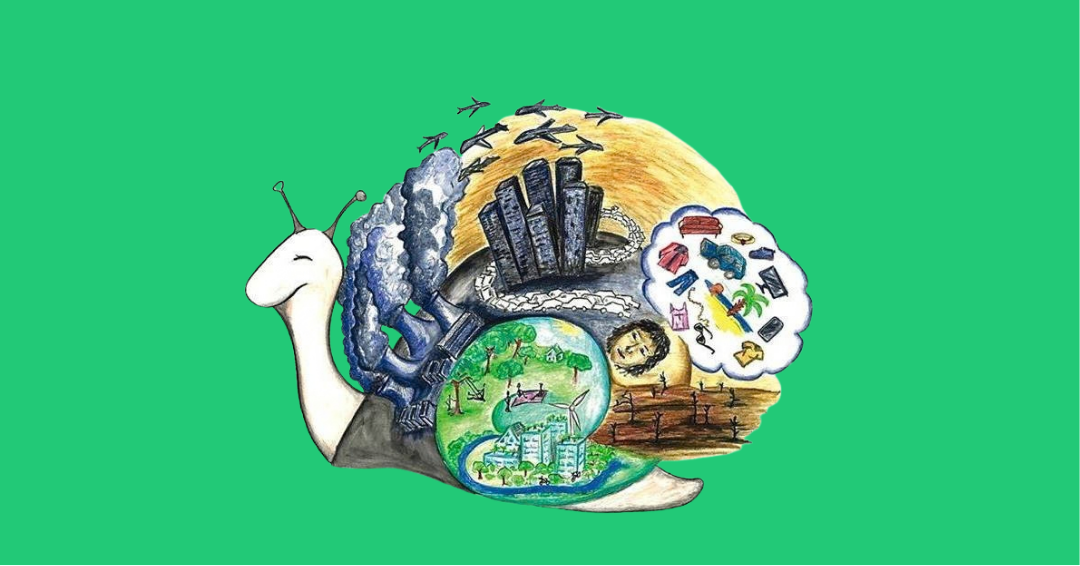
Credit: Augusto Metztli. Used with the artist's kind permission
There is an ongoing debate in Degrowth circles around the idea of reaching majorities as the only political strategic option for Degrowth, and around the need to create mass parties as the only way for that majority-building. Of course this is a discussion only in state-oriented Degrowth circles, for —unsurprisingly— anarchist degrowthists reject the whole party idea. But in my opinion the discussion is too focused on the question of how to reach majorities, when there is another possibility which is being systematically ignored: the effective political action through minorities, specifically minority parties.
The far-right has been proving for decades that an enormous influence can be played on government action, on laws, and on general political discourse even from outside political institutions or governments. Of course, now they have plenty of seats in many Parliaments around the world, and they are indeed governing or co-governing some regions and countries. But even when they were extra-parliamentary forces they began to introduce their political agenda through their direct or indirect influence on the moderate right. Recent developments in Spanish parliament have showed that this kind of minority power can be exerted not only by the far-right: Leftist and Nationalist parties with very few seats have been making big advances and had important parts of their agenda approved by a socio-liberal (social democrats with neoliberal policies) government in need of those few votes to pass any law. The strategic teaching here is of great relevance: even with a small —or very small— parliamentary representation, Degrowth could force some decisive and urgent policies when such political scenarios appear. Maybe it's a candidate for Prime Minister who needs a majority of votes in the chamber to be elected, or to go on in charge in the face of a non-confidence motion, or it may be a governing minority that needs to pass any important law. Whenever the right and the left side of the One Party as Chomsky would call it —we should better say the Pro-growth One Party— are in such a tie score that they need every single vote they can get from minority parties, the opportunity arises for what I have named the Mini effect, after an unusual situation that happened in 2015 in a small rural Galician town.
After the local elections of that year in Boimorto, the majority right and left Spanish parties (PP and PSOE), were nearly in a draw with 5 and 4 seats respectively, and with 2 seats for the Galician left-nationalist BNG. In the previous elections, BNG had accepted to give their one vote to PSOE to elect the PSOE candidate as Mayor and thus prevent a right-led government. But in 2015, BNG's 2 seats gave them greater bargaining power in front of a weakened PSOE. They took the oportunity to add an unexpected condition to the BNG-PSOE collaboration: the PSOE and BNG-supported candidate would be the local nationalist-municipalist leader Xosé Luis Rivas, a.k.a. Mini. And they did succeed: the majority of the Left (PSOE) supported the minority candidate (BNG) and in that way they got a nationalist Mayor for the first time in the town. Sadly, just two months after this election, one of the PSOE councillors betrayed its party and handed the local government to the Right. But that's another story, because corruption is always a menace, no matter what your political strategy is. What became clear in Boimorto is that whenever there is risk of losing governments to the Right, minority Left parties can exert a much greater influence than their quantitative representativeness could anticipate.
Podemos (a Leftist party which had previously co-governed at national level with PSOE) has recently demonstrated this again when they managed to pass their proposal of a massive regularisation of immigrants, because Pedro Sánchez's government desperately needed their 4 votes in a Spanish Parliament of 350. Interestingly enough, we must notice that Sumar —the minority part in the bipartisan Spanish government— had previously already advocated for this regularisation from inside the government, but unsuccessfully. Podemos, instead, saw the chance from outside, and when the government needed their votes, they played their cards to win. So, being the minority part of the government didn't ensure Sumar the power to pass this law, but being a tiny party outside of a government in need gave Podemos the power to force it. The Mini effect again!
This unrecognized power of minorities in partitocratic systems is the main reason why I strongly advocate for Degrowthist parties. The strategy of entrism in big parties, which many advocate, has proved itself ineffective: degrowthist individuals within growthist parties or degrowthist parties in coalitions with pro-growth parties, systematically tend to end up diluted and their pro-degrowth stance nullified, also creating frustration both in themselves and in their popular bases, which thus become more sceptical of the electoral road. It's been the case, for example, with Equo, a Spanish pro-Degrowth green party, after many years going to elections in coalition with Left pro-growth parties (Más País and Sumar).
So we face a series of cascading dilemmas: 1) Should we try the Degrowth agenda from the top or from the bottom? If we choose from the top or to combine both, we need to take part in elections. Then, we have dilemma number 2) Should we have our own party or should we enter the existing parties and try to influence from within? If we choose a separate party, then comes the following dilemma (trilemma actually) 3) Should it be necessarily a mass party, should we play as minorities going to elections in asymetric coalitions with pro-growth parties, or should we try to go on by ourselves to take advantage of the Mini effect when the occasion arises? My position is that Degrowth does need a party, and that it must not go into elections within non-degrowthist coalitions. This is supported by the fact that public support for Degrowth is currently sufficient —in some countries— to aspire at least to a few seats in those electoral systems that allow for minorities representation, even taking in account electoral thresholds.
Those seats could be used: a) to influence the rest of the Left; b) to educate people using the Parliament as a loudspeaker (via media coverage); and c) to take advantage of the weakness of pro-growth center-left governments, a very frequent situation these days. And all this, as an inseparable part of what we in Spain named dual strategies a decade ago. These strategies, similarly to Buneas' integrative strategies, Gregoletto & Burton's analectics, and Gasparro & Vico's sideways Degrowth, combine simultaneous and coordinated top-down and bottom-up approaches. They do it, ideally, in a dynamically modulated way: that's to say that when the electoral cycle demands it, more effort is put by activists in the electoral side of the strategy (campaigning for the degrowthist party), while bottom-up action is privileged the rest of the time (e.g., building prefigurative projects). Of course, when the Right and Left blocks are in a draw, an extra effort should be made to get as many votes as possible for the party, so that the Mini effect can be more potent.
Attracting the anarchists to degrowthist dual strategies is a key to their success, for many reasons: a) anarchists could represent a substantial part of electoral absentionism in countries like Spain with an important historical presence; b) their prefigurative projects could greatly benefit from State support or at least from its noninterference; c) there is a clear potential intersection and confluence between Degrowthism and Anarcho-syndicalism (in fact it's hard to find a pro-growth anarchist); and d) there are both historical precedents and current experiences inspired by Bookchin's libertarian municipalism as in Kurdish Democratic Confederalism. As I've been arguing since 2015, if the then-powerful CNT anarchist union could vote en masse during Second Spanish Republic elections and put aside their anti-State purity during the Spanish Civil War in 1936 (up to the point of participating with 4 ministers in the emergency government after the coup), why not do a similar thing today, given that the global ecosocial emergency is far more serious?
So, the ideal party won't only be a pro-Degrowth party but also a party aligned with the kind of socialism that fits within anarchism: libertarian socialism. It might sound strange for some, or even a contradiction in terms, but anarchist parties have always existed: one recent example was Partido da Terra in Galicia, also pro-Degrowth and defender of the idea of a leira básica (Basic Land Income). As we argued in D3, a minuscule and now extinct anti-party born of the 2011 Indignados movement, direct democracy could be inoculated in the representative institutions without the need to change a single line of the liberal Constitutions, aided by today's digital technology. And even without that, a pro-Degrowth anarchist party could be of great help in parliaments and in governments determined to lift the ¡No pasarán! barricade against the far-right. And, at the same time, it could use the Mini effect to support the bottom-up side of dual strategies with financial resources from the State, making it fund and protect grass-root resilience and post-capitalist experiences. Of course it will be hard for such a party to negotiate such funding and laws or to co-govern with pro-growth and pro-State parties, but CNT ministers' work during the Spanish War wasn't easy either. Despite that, those anarchist ministers got important things done in the field of social reform, and so can an anarchist/degrowthist-backed government in a small town, a big city, a regional government or even at national level, in these times of undeclared Global Civil War between Capitalism and Life.
This article is part of a spontaneous series on degrowth and strategy, which was triggered by a strong reaction to a Jason Hickel interview. The series is concerned in particular with the question of the state and party politics.
Find all articles in the series below:
Answer a questionnaire to contribute ideas on how we can reinforce the international degrowth movement in the years ahead

Militant-scholar, Ana Inés Heras, writes about collaborative projects between her research team at the Argentinean Council and various self-governed local communities and groups.

A degrowth strategy for societal transformation needs to combine several approaches, reflecting the plurality of degrowth as a movement. To support the myriad of bottom-up alternatives that are already out there, degrowth should put a special emphasis on strategies which build power outside of the capitalist system, be very cautious of those which merely seek to tame capitalism, but also integr...