

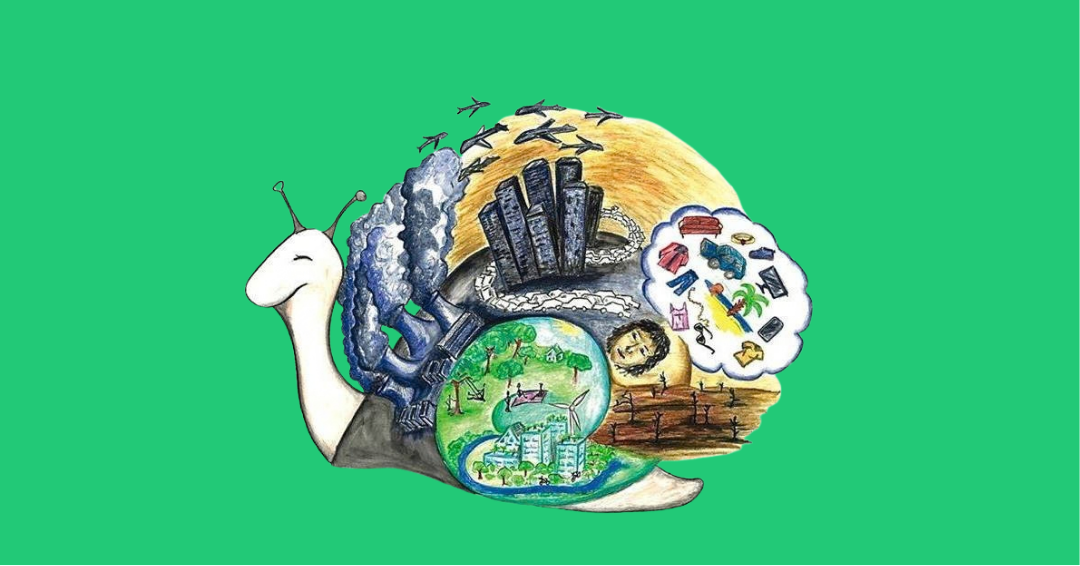
Credit by Brenna Quinlan
Jason Hickel’s intervention on strategies for achieving desirable futures argues for degrowth advocates to decamp to democratic socialism. He minimises degrowth to policies re-orienting production to satisfying people’s needs within Earth’s limits, and trivialises horizontalism as tiny prefigurative activities incapable of stopping capitalism dead in its tracks.
Our horizontalism represents our strongest difference with Hickel. So, here, we discuss the rich tradition and significance of holistic horizontalist philosophical, cultural and political approaches within the degrowth movement. Contra hierarchical approaches, a successful degrowth transition and vision requires horizontalist politicking and strategies.
The Constitutional Convention of the Association of Objectors to Growth in Beaugency (France), 19 September 2009, generated Degrowth: A Platform for Convergence. Highlighting the ‘Strategy of the Snail’, they rejected seizing power and exerting power-over, with a call ‘to create, without delay, conditions which will enable us to give full meaning to our lives’. Such horizontalist approaches highlight autonomy, substantive and direct democracy, and grassroots organising (see The Future is Degrowth and Routledge Handbook of Degrowth).
The term ‘horizontalism’ develops from ‘horizon’, a flat line, or ‘level’ in contrast to the vertical, the hierarchical. Horizontalists are anti-hierarchy, anti-capitalist, decolonial and pluriversal. Postcapitalist visions, strategies and ways of relating with one another and earth (nature) are horizontal, i.e. equitable and respectful.
Regarding the occupy movement, Marisa Holmes defines horizontalism as ‘sharing and building power with others’, as in John Holloway’s Change the World Without Taking Power (2002). Marina Sitrin’s experiential study, Horizontalism: Voices of Popular Power in Argentina (2006), describes horizontalidad as ‘affective politics’, the dignity of self-managed cooperatives, intentional cooperation, neighbourhood assemblies and collective agency. Similarly, the Objectors to Growth stated – ‘let us re-politicize society and socialize politics’.
Distinctions between horizontal and hierarchical approaches present the most divisive schism in current leftist politics. Hierarchical approaches to social change incorporate key capitalist structures, states and markets, as if useful for creating postcapitalism. Horizontalists have no five year plans, party disciplines, adored leaders or irreversible agendas. Horizontalists collectively plan and create futures in autonomous, self-managed, ways. Horizontalism emerges invisibly as a soft infrastructure of human relations. But collective work with earth takes a great deal of effort and interpersonal skills. This is what horizontalist activist movements do, they centre revolutionary change in the here and now.
Horizontal approaches have existed for millennia within equitable mutual friendships and, as analysed by David Graeber, within various communities. David Barkin describes numerous current Latin American communities with ‘cosmovisions’ grounded in collective sufficiency and symbiotic relations with earth. Marina Sitrin also refers to the horizontalism of autonomous Zapatista communities (Chiapas, Mexico); landless movements in South America and Central America; and Asian and African anti-capitalist resistance.
Horizontalism has emerged in revolutionary moments, say, in the Spanish Civil War. Even if broken in word and deed by patriarchal, class and racial prejudices, horizontalism has been relatively successfully adopted by such ‘others’. Horizontal practices evolved in 1960s and 1970s protests and activism, perhaps most obviously in consciousness-raising circles and everyday organisation of second-wave women’s liberation movements.
The approach is organic. Treat everyone as worthy of a voice. Learn to listen and attend to single testimonies through to a cacophony of voices. Stand one’s ground in a forum while holding hands with others of different opinions. Deliberate in assemblies, through open proposals, debates and revisions. Weave a consensus. Develop freewheeling but accountable working groups emerging from, and reporting to, assemblies.
Such approaches have established institutions in certain spaces. The grassroots Kurdish women’s movement (1990s–) organised against hierarchical state powers to institute quotas and co-chairing structures integrating women politicians. These holistic and grounded ways of operating express horizontalism, a far cry from patriarchal political practices of competition, self-interest and populism. Their gender consciousness training includes challenging hierarchical relationship between people and earth. As Gültan Kişanak writes: ‘Turkish political culture values a strong leader and managed society, but political women tend to aim for a democratic politics grounded in cooperation, collective will, rights, and responsibilities.’
Hierarchical relations tend to encourage horizontalist resistance in order to recover dignity. Contra hierarchical unity, horizontalist organising embraces personal emancipation as essential to revolutionary processes, means and ends. Degrowth and other horizontalist activists try to prefigure ways to effectively and efficiently fulfil essential needs, and establish new modes of governing. Caring and justice are guiding principles in everyday activities. Prefigurative skills transform us, strategically realising new relations, showing another world is possible.
Participants in co-operative spaces often incorporate horizontal practices, for example certain eco-cohousing communities, communes and political squats. The degrowth associated Haus des Wandels living and working space (Berlin) and Cargonomia cooperative (Budapest) are examples. Neither isolated nor introverted, they are strongly networked with like-organisations and partner with mainstream bodies. Resistance and challenges to capitalism via experimental and experiential prefiguration based on autonomy and collective provisioning are limited in the Global North. Still, collective prefiguration develops by seeking to avoid co-option, control and contortion by market and state forces, and by sharing learnings.
Significant pluriversal approaches strategically support the universal shift necessary to respect and nurture earth. The ‘pluriverse’ is often misunderstood and misrepresented as if it were ‘pluralism’, but it is not a handbag of approaches where anything goes. As the Global Tapestry of Alternatives team states, ‘[t]here is no one alternative, but a pluriverse of them, each unique, yet all aiming for just worlds’.
Pluriversal horizontalist practices adapt key principles of social and ecological justice according to peoples and places, cultures and ecological communities. This relational approach encompasses peoples from diverse backgrounds, as in revolutionary spaces of Zapatista and Rojavan communities; many Indigenous ‘territories of life’ communities; Latin American cosmovisions; and, Zones to Defend (ZADs). ZADs represent a movement of movements. Each activist and practitioner belongs to many movements, moving in and out of them, drawing on various political philosophies non-hierarchically.
Ashish Kothari and Arturo Escobar discuss pluriversity as anti-capitalist principles deeply respectful of humanity and ecology. Variety emerges by applying universal principles in customised local and regional ways. Open (re)localisation is a key strategy for spreading direct co-governance and shaping postcapitalist economies. Pluriversality is characterised in Zapatista’s autonomía and Indigenous practices of communalidad, where humans are just one species within ecosystems. Escobar et al. (2024: 165) conclude that ‘the pluriverse is the result of the dance between autonomy and interdependence that living beings and many place/territory-based communities perform … autonomy is a praxis of inter-existence’.
Certain municipalist co-planning and enabling policies diminish state control with power passing to the people. Likewise Samir Amin’s (2008: 63) pluriversal ‘construction of convergence in diversity’ includes anarchism as having ‘a necessary place’. Amin (2008: 124) appreciates that transformation requires that ‘people actually wield power’, acting inclusively and meeting everyone’s needs as both a means and ends – basic principles of horizontalism.
Pluriversality recognises needs for broad emancipation – embracing struggles against the patriarchy; narrow binary views of gender; and racial and ethnic persecution. Escobar et al. (2024: 162–3) speak of a ‘conceptual tapestry’ of ‘[t]erritoriality, community, autonomy, re-existence, pluriversal traditions, and politics in the feminine’ in creating ‘re-embodied, re-communalized, re-localized, and re-earthed’ futures.
In mature anti-capitalist alternatives with explicit postcapitalist prefiguration, pluriversal activities offer spaces for observing, experiencing and experimenting. They present ways of seeing and being beyond resistance. In defended occupations, horizontalist activists offer the strategic means to undercut the state. Horizontally influenced militaries and non-violent principles and actions are noteworthy. Critiques contribute to creating more successful strategies. In Zapatista and Rojava regions, and the ZAD Notre-Dame-des-Landes, people act with earth: ‘We are nature defending itself.’
Degrowth advocates’ strategic postcapitalist proposals include a total exit, liberation and emancipation, from capitalist imaginaries. Social democracy risks capitalist revival and counterrevolution by simply reforming the state and markets. A strategic alternative, detailed in the De Gruyter Handbook of Degrowth, is to abolish money and the state in favour of direct control of production. Following Samir Amin (1978: 114), communism means abolishing (exchange) value, class and exploitation, so we can determine our collective futures.
Capitalism is neatly defined as money making more money (M–M‘); money is a term and condition of capitalist production and exchange. In capitalist societies ‘value’ reduces to monetary prices and costs (exchange value). Monetary relations centre on direct control of humans and earth. Money is social credit created in a society of violent hierarchical dynamics, stolen and privatised property, the state, and markets. Money is the calculative operating principle of capitalist production. Therefore, no money = no capitalist practices.
To retain monetary relations, severely jeopardises social and ecological values. Anthropocentric monetary relations regenerate binaries between human being and other-than-human being. Even if insufficient, the strategy of going beyond money is a coherent and necessary step to deliver optimal social and ecological outcomes. Otherwise, state and markets permit constant challenges via capitalist/monetary practices. The abolition of money is a strong strategy for identifying and resisting counter-revolutionary practices, and facilitates ‘real values’ (social and ecological values) becoming the basis for collective provisioning.
Even in advanced capitalism, everyone experiences some nonmonetary practices – gifting, volunteering, solidary acts for family and close friends. Abolishing monetary practices facilitates generic commoning, co-governing and collectively provisioning for people’s and earth’s needs. The Notre-Dame-des-Landes ZAD adopted common sharing infrastructures, such as non-market and pay-what-you-want events, free services, spaces and stores. Claudio Cattaneo illustrates how political squats tend towards money-freedom and collective sufficiency. Anitra Nelson shows how eco-collaborative living–working cooperatives based on autonomy and money-freeness can form a bridge to a non-monetary future. Internally money-free communes organising with ‘one purse’ try to externalise monetary relations. Twin Oaks Community in Virginia (United States) is a reference case exemplifying considerable community sufficiency.
Collective nonmonetary experiments are constrained and contorted by capitalist environments, resulting in ‘prefigurative hybrids’ analysed by Terry Leahy in System Change: For a Liveable Future (2025). In revolutionary moments, such as the Spanish Civil War, and stages in societal revolutions, such as in Russia and Cuba, fierce debates and experimentation took place on whether and how to dispense with money. Many traditional and current relations and practices of Indigenous peoples avoid money.
Most contemporary democratic economic planning modellers acknowledge challenges posed by monetary accounting. Abolishing money to construct futures oriented around socio-ecological values is a strategy advocated by analysts such as Marxist philosopher John Holloway, autonomist Marxist Harry Cleaver, and independent economist, historian and scholar-activist Friederike Habermann. A Volkswagen Foundation funded Society after Money team incorporates various streams of thought. Within degrowth, see Andreas Exner et al. in Degrowth in Movement(s), the unconditional autonomy allowance outlined by Vincent Liegey et al. in A Degrowth Project and in Exploring Degrowth, and the gift economy work of Terry Leahy. Nonmonetary strategies draw on strands of ecofeminism, ecological economics, non-market socialism and Kropotkin-style anarchism, as in Anitra Nelson’s Beyond Money (2022). Also, the Socialist Party of Great Britain is distinguished by its non-monetary line.
Rather than no politics at all, such analysts and activists eschew the traditional disciplinary and hierarchical culture of socialist organisations. They prefer a politics of engagement and consensus highlighting everyone’s right to decide and right to basic needs. Both human and more-than-human being are regarded respectfully and with agency. The pluriverse, horizontalism and emancipatory postcapitalism are, and always will be, works in progress.
We are at the edge of an abyss. Time is not on our side. Capital has not collapsed but people and ecosystems have. Democratic socialist strategies focus on workers as key revolutionary agents, proposing that state and markets can fulfil socialist purposes. But no existing cases have achieved full equality or democracy, let alone degrowth.
Horizontalism envisages humans living respectfully with other-than-human nature. Horizontalism regards all people as necessary agents in creating new structures and a new social metabolism. We regard horizontalism as the spine of degrowth – offering the greatest chances of success for realising degrowth futures.
It is a movement
It is a movement
I tell you.
It is a movement.
With a dynamism
of its own being.
As wicked and
warming as fire.
It is a movement.
It is a migration
from resistance
and survival
to direct co-
governance.
It is a movement.
Doing it ourselves
with one another.
And with Earth.
A revolution as in
Earth around Sun.
It is a movement.
There is no place
for us nomads here.
We pack up.
The winds blow
us like leaves
into clusters.
We say au revoir.
Keep safe. Let us
remember our smiles
so as to recognise
one another on
the other side.
Don’t wonder when.
There is no
temporal or spatial
measure for a
movement
to realise its
unique ends.
Just as there is no
measure for life
itself. Neither
years nor influence
can measure it.
Don’t look so
surprised.
We are moving.
Going. Creating.
Doing. We are
a movement
within movements.
So many movements
co-evolving towards
places and beingness
to sustain us.
It is a movement
that dances from
the communal soul.
It is a writhing.
It is a song.
It is a movement.
It is a prayer.
Anitra Nelson 25 October 2025 – a response to Jason Hickel’s statement that degrowth is not a movement.
This article is part of a spontaneous series on degrowth and strategy, which was triggered by a strong reaction to a Jason Hickel interview. The series is concerned in particular with the question of the state and party politics.
Find all articles in the series below:
Answer a questionnaire to contribute ideas on how we can reinforce the international degrowth movement in the years ahead

Jason Hickel responds to critics of his interview published in the summer, therefore continuing the debate around "what is degrowth" and around the strategies to achieve degrowth.
This article summarises a proposal for reworking degrowth conferences that was developed in a workshop held by the Transformative Learning Circle (TLC) of the International Degrowth Network (IDN) at the 2024 International ESEE-Degrowth Conference in Pontevedra