
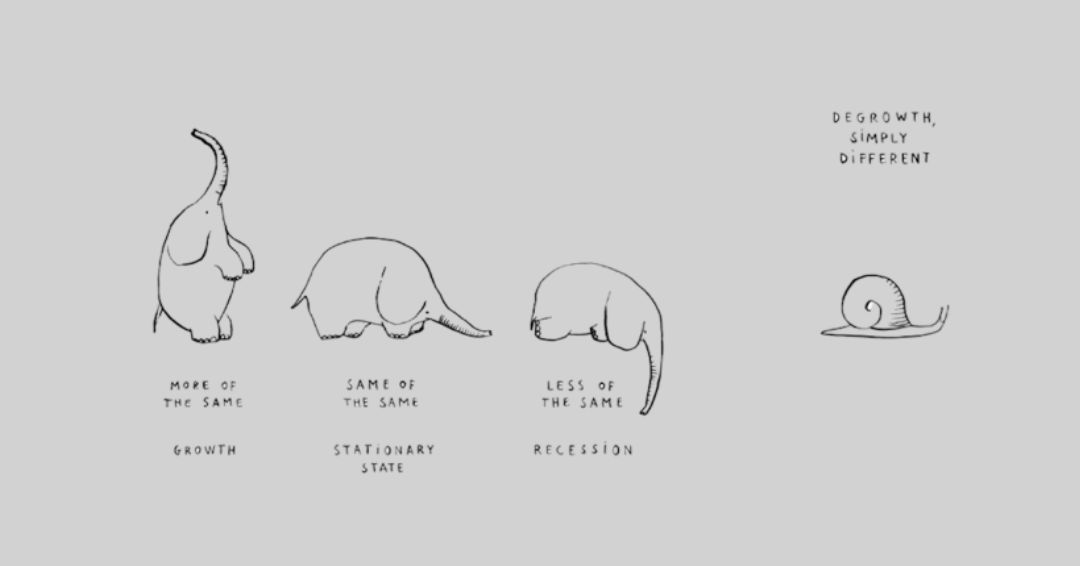
Credit: Bàrbara Castro Urío
Degrowth gone wrong?
These days everyone seems to think degrowth is heading the wrong way.
Serge Latouche and the journal Decroissance lament the English word ‘degrowth’ and academic ‘degrowth studies’, which they view as a contraction economics that betrays decroissance’s critique of economic reason. Some in this blog worry degrowth is becoming too centralist and socialist, and others, too prefigurative without real claims to power.
Then comes Clive Spash to top it all off with a long list of ‘what is wrong with degrowth’. Degrowth, Spash argues, is becoming indistinguishable from eco-socialism (thanks to Jason Hickel). Degrowth is reproducing growth mindsets with adjectives like “thriving”, “prospering” or “flourishing” (Tim Jackson and Kate Raworth to blame here). Degrowth is watered down by affiliating with post-growth (Jackson), doughnut economics (Raworth), and the steady state (Tim Parrique, Dan O’Neill), approaches not critical of capitalism and approving of growth, if up to a limit. Despite the hard doughnut crust - sorry, boundary - of these approaches, Spash is also worried that degrowth denies the existence of limits, cozying up to climate deniers (thanks to none other than yours truly).
Now, I have also my litany of ideas I wish degrowth had not left behind (anti-utilitarianism, gift economics and especially depense), drifted as we have to urgent questions of policy, strategy and ‘what is to be done’. But I will spare you my grievances for a future article. My point here is that degrowth has not gone ‘wrong’, because there was never ever a moment when degrowth was ‘right’.
From the very beginning when I, along with the Barcelona crew, encountered degrowth, back in the first conference in Paris, in 2008, degrowth was a potpourri, in the good sense of the term. Different ideas, epistemological and theoretical traditions, and political predispositions were brought together by a minimum common denominator: the critique of the imperative of endless growth, and the belief that there is an alternative. What exactly was the problem with growth, what was the alternative, and how it could come about, was far from agreed – it was hotly debated and still is. And this is what attracted me to this community: a strong conviction, side-by-side with an undogmatic openness.
It is easy now to romanticize the past, as Spash does, and argue that some time back, there was a pure version of degrowth which is now being corrupted. This is simply not true. Spash mentions Georgescu-Roegen, Andre Gorz or Serge Latouche as patrons of degrowth from which next generations drifted away. Many of the problems Spash now sees in degrowth, however, can be traced back to the contradictory views of these very thinkers.
Spash criticizes Hickel, Jackson or Raworth for greenwashing growth by saying that growth can be good up to a point, or when it alleviates poverty. But didn’t Georgescu advocate too that “underdeveloped nations must be aided to arrive as quickly as possible at a good (not luxurious) life”, a process that, as Hickel and others argue, will produce growth, even if growth is not the objective? Georgescu went even further pondering more generally on “the destiny of man .. to have a short, but fiery, exciting and extravagant life rather than a long, uneventful and vegetative existence” – exciting being life under fossil-fueled capitalism, and boring under a solar-powered agrarian degrowth future. Spash must disagree also with Georgescu when, economist as he was, linked value to ‘the still mysterious flux of the enjoyment of life”, aka utility.
Or take Andre Gorz. Gorz is remembered as a critic of technology, but Gorz celebrated the potential of modern industry and technology to liberate time - conviviality for Gorz meant freely disposable time. Compare this to another degrowth precursor, Ivan Illich, who advocated against industrial tools and called convivial tools the (low-tech) tools that humans can autonomously govern.
Gorz was indeed the first to mention decroissance in a public debate on the Limits to Growth report. But Gorz’s take on limits was much more nuanced than the Club of Rome’s and what Spash allows for. In Political Ecology: Expertocracy versus Self-limitation, Gorz castigated the idea of technocrats defining, measuring and imposing limits. Gorz called for limits that are chosen not imposed: collective, democratic decisions about what is enough.
This parallel legacy of degrowth thinking on limits, which unlike what Spash claims has nothing to do with ‘lifestyle politics’, underlies my book Limits. My warning to environmentalists, like me, who by training and professional instinct, and for reasons of communicative expediency we frame limits as a boundary ‘out there’, is that this feeds into capitalism’s spirit, fuelling the reverse reaction of a desire to overcome these limits – witness the lunatic plans of billionaires to colonize space.
Climate change is obviously real, but there is no reason to frame it as a limit and not as what it is: a destructive process/outcome. Climate breakdown is ruining the lives of the most vulnerable, foreclosing the futures of youths. Every decimal in temperature rise matters - it is a limit we should collectively choose to stay within. I don’t care if climate change poses ‘a limit to growth’ - I care whether we can limit growth before it is too late. And unlike Georgescu, I think that living within limits can be much more exciting and extravagant than growth without limits.
What about Serge Latouche then, the first great academic popularizer of degrowth, thanks to whom many of us discovered degrowth? Unlike contemporary degrowthers, Spash tells us citing Pelizzoni, Latouche had a realist/biophysical definition of degrowth as “stopping growth” and “shrinking energy and resource throughput”. But wasn’t it Latouche also who called degrowth a missile ‘slogan’, and an atheist’s attack on the religion of growth, rather than a reversion of growth? Didn’t he, in other instances, define degrowth as a “society of frugal abundance” (alert: growth mindset word in use) or as a ‘matrix of alternatives’ in transition to an autonomous, convivial society?
Early mainstream critics of degrowth claimed degrowth was “wrong” because it mobilized inconsistent definitions. And our defense was precisely the power of these multi-rooted - somewhat aligned, somewhat in tension - significations, which we captured in a vocabulary of cross-linked dictionary entries, loyal to Latouche’s own spirit, whereby degrowth cannot be reduced to a vulgar-materialist ‘reduction of x’ only.
Latouche’s seamless writing married contradictory takes on limits, technology, or development, and different entry points to degrowth were made to seem harmonious. Gorz, Illich and Georgescu were presented as part of one intellectual family. Post-development cultural critiques of Westernization were put side by side with anti-colonial thinkers who were in favour of sovereign socialist development. Anthropological critiques of the ‘invention of the economy’ were accompanied by economic programs of income caps and working hour reductions.
Latouche, one may say, is a ‘trickster’ political ecologist par excellence: realist on one occasion, constructionist on another, anthropologist in one venue, economist elsewhere. He can question how economics colonize our imaginary, but when Onofrio Romano criticizes him for forgetting his anti-utilitarian roots, Latouche dismisses Romano’s philosophizing as impractical and unimplementable. Latouche can criticize economistic reason but then respond to Greek journalists during the crisis with full-on economic advice to Greece to exit the Eurozone and implement local currencies. Latouche criticizes degrowth academics for doing “contraction economics”, but he first called degrowth “a virtuous cycle of quiet contraction”. He might dismiss degrowth models as ‘degrowth studies’, but it was him proposing a degrowth policy program, leaving those of us following up on his work attacked by frenzied critics and having to model and ‘prove’ that this program could work.
I call Latouche a trickster with amicable admiration. He is a role model I aspire to replicate, if with somewhat more modesty. The beauty of Latouche’s books, the best writings on degrowth to date, is how they capture and orchestrate all the diverse ideas and traditions that degrowth came to embody, pre-figuring the wild and untamable community of people from different disciplines and with different viewpoints that came together in Paris in 2008. Spash was not there, but Tim Jackson was (alongside other steady state enthusiasts like Peter Victor or then PhD student Dan O’Neill), and he freaked out, as he would share in a footnote in his book, when a Frenchman interrupted him, telling him that there is no place for economics in a degrowth conference. To his credit, Tim stayed on and is part of this uncomfortable alliance with people who find what he does wrong.
The degrowth community is today a diverse, pluriversal community, with different epistemic and political positions, including everyone from sufficientists and ‘immanent reformers’ to ‘voluntary pacifists’, modernist socialists and alternative practical anarchists. Feminists joined the community with force shortly after the Leipzig conference (with the Feminist and Degrowth Alliance), while the anti-imperialist delinkers set up their tent at last Summer’s Oslo conference. All is good and going according to plan - a plan that does not exist.
The problem is that many think there is a problem, and the problem for them is that degrowth is not going towards their own preferred way. We should propose policies to appeal to left politicians and mass electorates – no, wait, we should stay out of the halls of power and be the change we want to see. We should set up a political party and conspire on how to take power – no, wait, we should call for sabotaging fossil fuel infrastructure, occupying houses and living differently in the cracks. We should model how a degrowth scenario could unfold, and what political interventions could propel it – no, wait, we should deconstruct economistic reasoning, and study ethnographically people who already live differently.
What if, instead, we were all to relax and cherish the plurality of political and exploratory pathways opened by degrowth? What if we let egos go and live with the productive conflicts difference gestates? What if we were to accept that, like in the case of our arch-nemesis, growth, there will be different theories of degrowth too, and different political proposals for achieving it?
This is not a case for ‘anything goes’ or an ‘all of the above’ strategy, but a call to let all flowers blossom: the most beautiful ones, the ones most apt for our times, the ones that most creatively articulate differences and forge alliances, will survive. What if we modeled ourselves after a loud, argumentative Mediterranean family that is having dinner, quarrelling and disagreeing about everything and nothing, before going home and loving (and hating) each other to death – but still being a family?
I don’t underestimate Spash’s or anyone else’s critiques. Critiques, if meant to be internal, are welcome to the family dinner. Spash’s integrity and uncompromised stance against anything that smells of neoclassical economics or brings growth back through the backdoor is undisputable. His criticisms point to questions that keep me awake at lunchtime when my body otherwise begs for a siesta: are there non-growth alter/post-development paths for non/less industrialised countries? Is growth good up to a point or has it always been a destructive, colonizing project? How can we communicate degrowth without reproducing growthist common senses, and how can we subvert such common senses without being co-opted? What do we lose or forget when we try to quantify and model degrowth, or when we talk of post-growth or ecosocialism instead of degrowth? Should we enter the European Parliament or not?
It is the spirit of Spash’s critique that I take issue with. There is an easy path, especially for academics and leftist-progressives, to take: head on with our uncompromising party of one, dismissing everyone else as a sellout. To the other extreme, we can be agreeable and form well-feeling alliances with everyone, becoming irrelevant and being swallowed up. And then there is a middle path, where we carefully stitch plural and tense alliances and agendas with like, but not identically-minded, others, with whom we agree to disagree – but with whom we know we disagree much less than with all those others out there.
The degrowth community has taken this middle path. And it should remain steadfast in its course.
This article is part of a spontaneous series on degrowth and strategy, which was triggered by a strong reaction to a Jason Hickel interview. The series is concerned in particular with the question of the state and party politics.
Find all articles in the series below:

What power can minority parties have in partitocratic political systems? Manuel Casal Lodeiro joins the ongoing strategy debate and argues for the significance of radical degrowthist parties.

Here we are again: a position in the degrowth movement becomes apparent, strong, almost dominant, and the other side responds, feeling misrepresented. And in reacting, it inevitably ends up claiming to be the herald of the “true Degrowth” and rejecting the contribution of the other side.
This piece will close the ten-part degrowth.info series on strategy, highlighting some of the key insights and charting the development of the strategy debate within degrowth. We will then offer some insights on how our own understanding of strategy and degrowth has changed over the last two years since we first urged the community to engage with this topic more. Finally, we will consider the p...