
By Christiane Kliemann
Alberto Acosta, economist and father of the Ecuadorian constitution, made very clear in his opening speech, that it is not enough to simply do away with the growth paradigm if we miss to build up a different world altogether.On the example of a news article on the possibility of an economic recession in Germany and the devastating impacts this would have on other European contries, he pointed out that it is impossible to have a growth-economy without having actual growth. He called on the more than 3000 people gathered in Leipzig at the conferece to establish connections between the global North and South which he sees as the two sides of the same coin: People here and there are concerned about the same issues, and so their different perspectives belong together in the struggle to create global change.
The numbers he quoted - 85 individual people holding more private assets than 1,75 billions of the poor - are the best evidence that the world is in dire need for alternative models - and that degrowth has to go hand in hand with putting an end to extractivism. He asked whether we will really have to destroy our planet before we manage to turn our economy around and implement new economic models based on the needs and limits of societies. We shouldn´t tolerate poverty and hunger, as we are already producing enough food and could theoretically even feed 11 billion people which is merely a matter of distribution.
He mentioned the Latin American example of "Buen Vivir" and emphasized that humans are living organisms and parts of nature who should move away from anthropocentric thinking and start recognizing nature in its own rights. He called for a short-term, a medium-term and a long-term vision, going along with concrete steps in a democratic, bottom-up movement based on community-driven solutions.
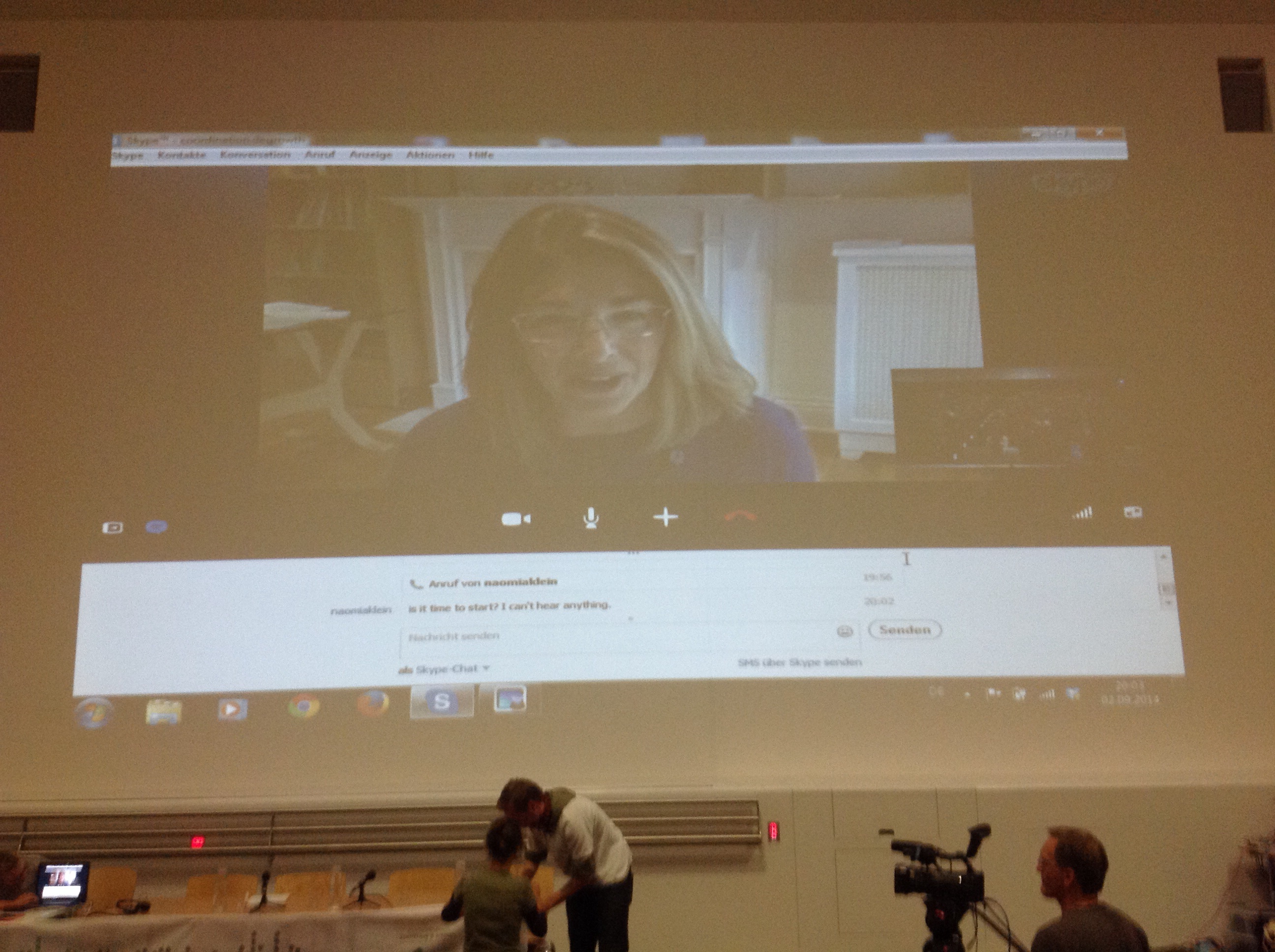
Along similar lines, Naomi Klein underlined in her video-address from Canada that keeping up the status quo cannot be an option and that radical changes are the only option left. She added that climate change will change everything we know about our physical world unless we manage to make radical changes ourselves. Accordingly, her new book is called "This changes everything - Capitalism versus the Climate", which provocingly expresses her perception that everything is easier than imagining to change capitalism.
She made clear that, when it comes to addressing the climate crisis, we as humans have failed catastrophically, not in theory, but in practice, given that the first climate negotiations started in 1990 and emissions have gone up by 61 percent since then, which brings us on a path towards a four to six degree-rise.
She sees the establishment of the global free-trade-regime in parallel to the climate negotiations as one of the main reasons for the failure to address climate change, as well as the denial of the governments in the global North to take on their responsibility for having caused it and their ignorance towards supporting its victims.
The arrival of smartphones, self-driving cars and the Cloud are all symptomatic of a profound shift that is re-writing modern society from within: the Fourth Industrial Revolution. New technologies claim to provide answers to a host of problems, but is technology unbound always a force for good? In the first of a three-part series on the Fourth Industrial Revolution, EcoPolítica’s Paz Serra...

After almost a year of tireless work we are proud to present our degrowth library. Here you can find various materials related to the transition to an economy independent from economic growth. The library already contains almost 700 entries, from introductory videos to newspaper articles and scientific publications in different languages. Diverse search options and an extensive list of themes m...

Australia’s two-speed economy, in which those engaged in mineral extraction flourish while the rest flounder, seems to have only one direction: up. Not that people really stop to think why. Most Australians, if you asked them, would stare blankly if you mentioned degrowth, or crack a joke about how it’s tantamount to devolution. It seems [...]