
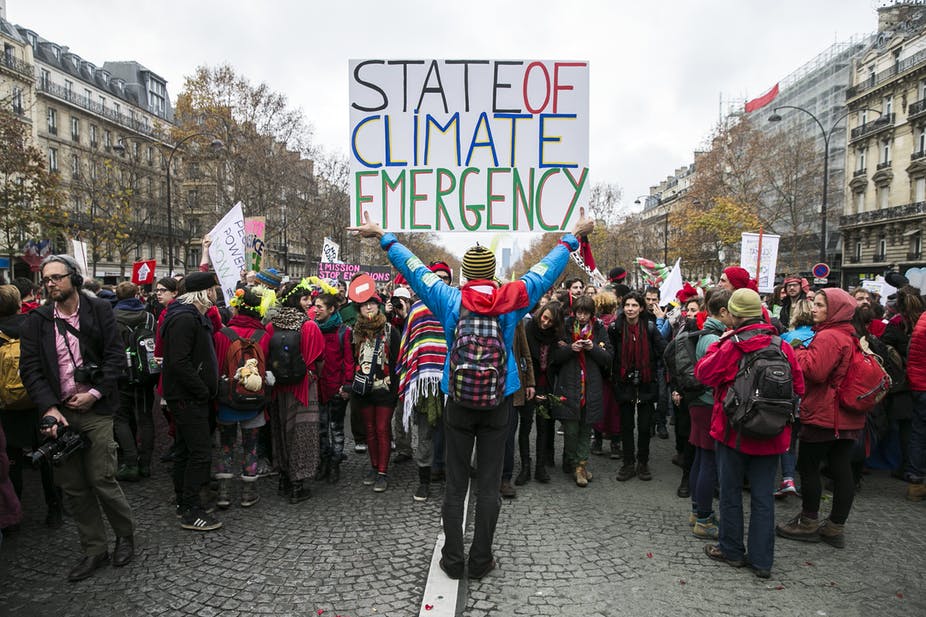
At the COP24 conference in Poland, countries are aiming to finalise the implementation plan for the 2015 Paris Agreement. The task has extra gravity in the wake of the recent IPCC report declaring that we have just 12 years to take the action needed to limit global warming to that infamous 1.5ᵒC target. Although the conference itself is open to selected state representatives only, many see the week as an opportunity to influence and define the climate action agenda for the coming year, with protests planned outside the conference halls. A crucial role of environmental activists is to shift the public discourse around climate change and to put pressure on state representatives to act boldly. COP24 offers a rare platform on which to drive a step change in the position of governments on climate change. However, many environmental movements in Europe are not offering the critical analysis and radical narratives needed to achieve a halt to climate change. Read more: Extinction Rebellion: I'm an academic embracing direct action to stop climate change
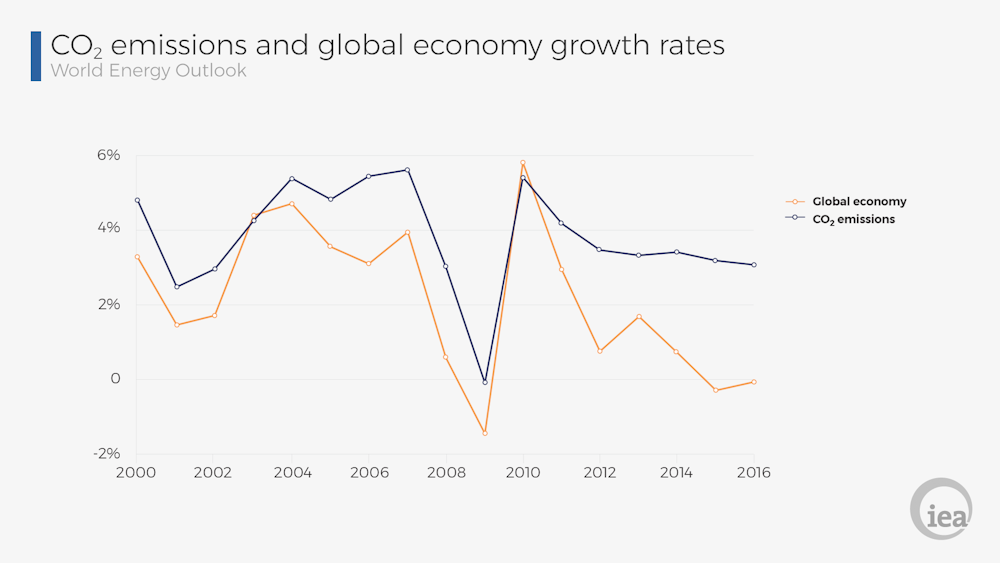 Economic growth and carbon emissions are closely linked. International Energy Agency
Practically, what this means is that as long as economic growth continues to expand rapidly and indefinitely, so too will the quantity of CO₂ in the atmosphere and the associated environmental and social impacts.
To address climate change, therefore, we must address the root cause of this planetary ailment: the ideology of growth first, growth always. By moving away from growth-oriented societies in Europe and other advanced economies, towards ones that prioritise environmental and social health, we stand the slimmest chance of solving our climate crisis, while still allowing the poorest economies globally to meet their economic needs.
Economic growth and carbon emissions are closely linked. International Energy Agency
Practically, what this means is that as long as economic growth continues to expand rapidly and indefinitely, so too will the quantity of CO₂ in the atmosphere and the associated environmental and social impacts.
To address climate change, therefore, we must address the root cause of this planetary ailment: the ideology of growth first, growth always. By moving away from growth-oriented societies in Europe and other advanced economies, towards ones that prioritise environmental and social health, we stand the slimmest chance of solving our climate crisis, while still allowing the poorest economies globally to meet their economic needs.


We live nextdoor to my partner’s grandmother, Maria, who was born during the Second World War in Northern Italy. This means that she knows what hard times look like. Maria could not believe we would be using washable diapers for our baby boy. With genuine surprise she asked me, “why?”, and then she was curious in which pot we were planning to boil the diapers. In her eyes, we could not possibly...
Boris Woynowski und Ludwig Schuster sind aktive Mitglieder des Netzwerkes Wachstumswende. In ihrer Rolle als Mitgründer der Thinkfarm, eines kooperativen Gemeinschaftsbüros in Berlin, haben wir ein Videointerview mit ihnen geführt, das fiktiv im Jahre 2030 spielt und in dem sie gemeinsam auf die schwierige aber spannende Zeit eines gesellschaftlichen Wandels zurückblicken.
Die Krise der gesellschaftlichen Naturverhältnisse ist auch eine Krise der gesellschaftlichen ReProduktionsverhältnisse. Dies ist der Ausgangspunkt der queer-feministischen Kritik an den alternativen Ansätzen, die unter den Schlagworten Green New Deal, Postwachstum oder Solidarische Ökonomie verhandelt werden. Während die Strategien des Green New Deal auf eine ökologische Modernisierung der Industriepolitik abzielen, stellen Postwachstumsdebatte und Solidarische Ökonomien [...]