
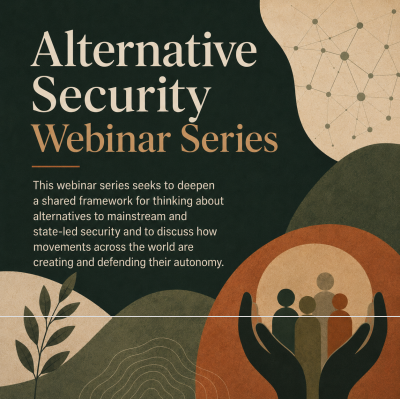
When? June 4th, 2026, 1pm GMT
Where? Online, register here
This is the first of a series of webinars that will open the series with a conceptual discussion on security in a time of deep civilizational crisis. It will examine how security has traditionally been framed through the international order, the nation-state, sovereignty, militarization, and the management of threats, while asking how communities and movements are challenging this paradigm today. The conversation will explore how alternatives to security are being articulated through autonomy, care, territorial and collective self-defense, direct democracy, and community-based practices that defend life beyond the state-centered security framework.
Speakers: Manuel Rozental (Colombia), Deepa Sinha (India) and (TBC)
The Global Tapestry of Alternatives "Alternative Security" Project explores how communities and movements are challenging dominant security paradigms rooted in state power, militarization, surveillance, patriarchy, colonialism, and extractivism. Rather than asking how security can be reformed within existing systems, the project asks how communities are already building alternatives to security through autonomy, care, territorial defense, collective self-organization, community justice, and the reproduction of life beyond state and market logics.
This webinar series seeks to deepen a shared framework for thinking about alternatives to mainstream and state-led security by bringing together grassroots movements, researchers, and allies from different regions. Across three 90-minute sessions, the series will create a space for cross-regional dialogue on how communities facing militarization, surveillance, criminalization, extractivism, and war are redefining safety, protection, autonomy, and collective well-being from below.
I come from the dark side. Between 1994 and 1999, I studied at two business schools. Then I worked in advertising and marketing from 1999 until 2016 — for 17 years. First I was an employee in a couple of advertising agencies. Then I got a doctorate in Marketing and helped build our own specialised agency, with a group of friends and colleagues. The one over-riding goal of everything was alwa...
By Giorgos Kallis The ecomodernist manifesto is the latest and most visionary document under the auspices of the ‘post-environmentalist’ think-tank the Breakthrough Institute. I first heard the Institute’s founders Ted Nordhaus and Michael Shellenberger speak at Berkeley some eight years ago, presenting their case for the “death of environmentalism” (hence the ‘post’ prefix). For half of the p...
Interview with Ole Bjerg Ole Bjerg is associate professor at the Copenhagen Business School. He writes for the ephemera Journal and is one of the organizers of the conference "Organizing for the post-growth economy". He gave us a short interview for the Stream towards Degrowth. Imagine we're living in the future, say in the year 2030, in a time of well-being. Humanity enjoys a good life ...