
Credit by Yuri
Looking back upon past versions of our yearly wrap-up format, we rage to notice that the year in question is the only detail we need to change for it to be up-to-date. As we wrote in the past, we could state again that 2025:
“...has been another year of escalating social and ecological crisis, where state and corporate actors continue to violently stifle determined efforts from below to avert further breakdown of our communities and life systems, and create just futures for all on this planet.
We have seen - once again - record breaking summer temperatures, more climate disasters, brutal imperial onslaughts, and the continued rise of far-right authoritarianism around the world, with huge swathes of the global population suffering from each of these.”
The imperial growthist exploitative system is still well in place, yes. But our response, our reflections and our strategies are evolving every year. In this piece, we want to share some of the important evolutions within our collective at degrowth.info and our reflections after a busy year.
For 11 years now, we have been sharing information about degrowth; yet it is only this year that we have started identifying ourselves as an independent media platform. We feel an ever more pressing need to stretch ourselves to reach a broader audience outside the existing degrowth networks, if we are to play a role in expanding these networks. This has involved a series of changes, including: a greater focus on our communications (social medias and newsletter), a larger number of pieces published (from 14 in 2024 to 33 in 2025!), a collaboration with the media “The Himalaya Collective”, hosting a debate on different visions of degrowth (Nelson et al, 2025, Gasparro and Vico, 2025, Hickel, 2025), recording a video about “what is degrowth”, updating our visual identity, and publishing a blog series on “Movements for social and environmental justice worldwide”.
As we newly defined ourselves as an independent media, we reaffirmed our editorial line: communicating the diversity of degrowth in an accessible way. One specific aspect of this editorial line means that we strive to platform voices that are often less heard in the degrowth movement, such as those from the Global South.
Our blog series on “Movements for social and environmental justice worldwide” represents well this editorial line. A range of authors, topics, geographies and methods were covered: from unionism to activism and sabotage, from resistance to legal tools, from academia to civil society. The series shed light on the extent of what there is to learn from other movements. There is no one route to transformation, and exchanges and collaboration are key to success.
We are grateful for the variety of pitches we received and are pleased with the nine pieces that made their way into publication. Yet we did hit a few hurdles. The one we dreaded most, the elephant in the room: the under-representation of Global South voices. Degrowth cannot be envisioned as a transformation in the Global North, isolated from the rest of the world; a world strangled by (neo)colonialism and dispossession, genocide and international complicity.
As per our editorial line, it was our explicit intent to platform authors from the Global South, as we believe these struggles are not visible enough in degrowth spaces. In order to overcome the language barriers and reach potential authors beyond our mostly Europe-centered audience, we published the call for pitches in different languages on social media and tagged many groups and networks our team was aware of and whose work we thought was inspiring. We offered authors to write in their native language. We also ensured financial compensation for anyone who needed it. As a result, a number of articles were published by authors from outside of our usual circles, and new connections to other networks were created.
But we can't rejoice too quickly, nor fall into the trap and insult of tokenising a few authors. In terms of geographic diversity, we did not manage to cover any Asian movements – just one of the many gaps in our coverage. We also noticed that many pitches about Global South movements came from Global North authors, often in the context of university research. A few of these did get published as part of the series, because we thought their content was rich and insightful. Yet we think it should not be enough to stop at an external gaze, no matter how thorough the research or how well intentioned and well acquainted with the local situation the author might have been.
Reflecting on these difficulties to platform voices that are often less heard in the degrowth movement, we consider the main barriers to be:
Considering historical debt and ongoing exploitation, what then should be the relationship between Global South and Global North movements? How should we talk to one another? What can we expect from each other – indeed, what is our responsibility, as the degrowth movement, and what does it mean concretely? It is one thing to say we want to collaborate and support, but this series has shown it is another to actually build the bridges.
While both this series and 2025 come to a close, we do not stop paying attention to what is happening in other movements, in other parts of the world, and we do not stop grappling with those questions of majority-minority world relations.
With solidarity, we wish you a happy end of the year.
As degrowth becomes a more familiar term worldwide, a loose informal network of Australian degrowth activists, scholars and advocates has emerged into the formal Degrowth Network Australia (DNA). The network has a public launch in a participatory degrowth workshop at 2pm–4pm on 26 February 2023 — a National Sustainable Living Festival event at the Black Spark Cultural Centre in Northcote, an inner suburb of Melbourne (Victoria, Australia).
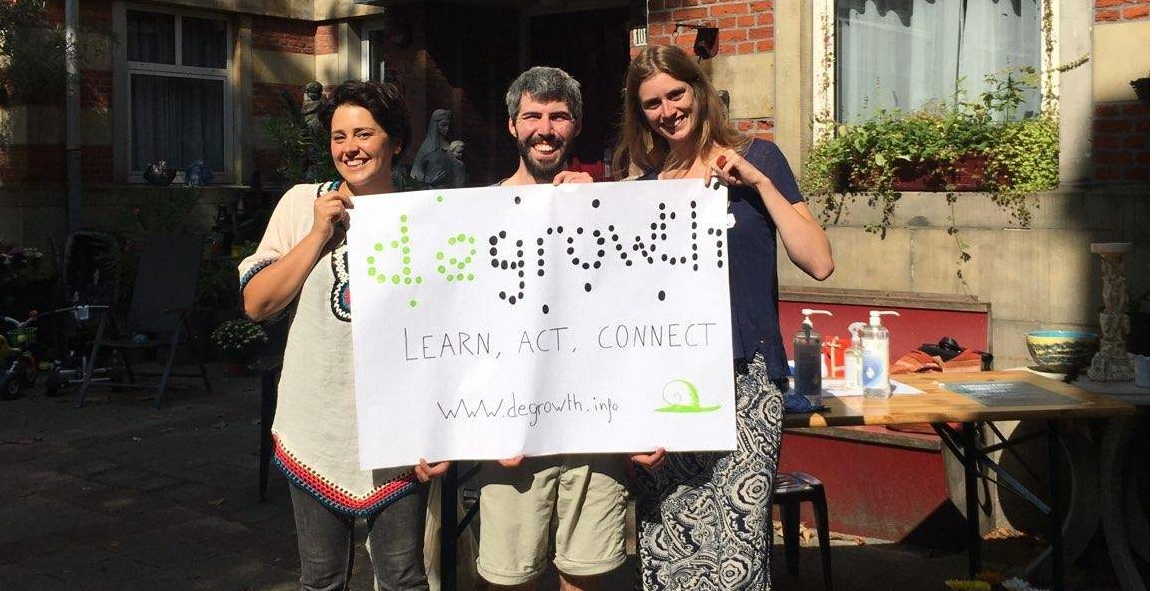
As the world around us changes, so do the ambitions of degrowth.info. In this post, we share some reflections on the past year of our collective and set out new directions for 2023.

After decades of research, the time has come: degrowth now has its own journal.