
The degrowth-conference took place in Leipzig in September 2014. Fortunately, the collected voluntary participation fee was higher than expected. This enables the conference team to allocate 9.000 Euro for project funding.
Be it the promotion of discussions, the generation of knowledge, the education of people or a practical activity: The money should go to support small projects and courageous initiatives towards degrowth. It is planned to fund a minimum of 5 projects with 500 up to 2.500 Euro in the year 2015.
Deadline for applications is the 1st of September 2015. > Here you can find more information.This article is part of a series on degrowth.info discussing strategy in the degrowth movement. The introduction to the series and an ongoing list of contributions can be found here. In a previous piece in this blog series, Joe Herbert and colleagues pointed out the “how to move towards a degrowth society” gap in degrowth discourse. As I have also come across this “how to get there” question...

In a recent post, a group of authors expressed their concerns that degrowth risks being lost in pluralism and argued for the need to co-produce a mix of context-sensitive strategies. I believe this re-stirring of the debate on strategy in the degrowth movement is both relevant and timely. While I agree with many of the authors’ concerns, and proposals, I would here like to propose a somewhat di...
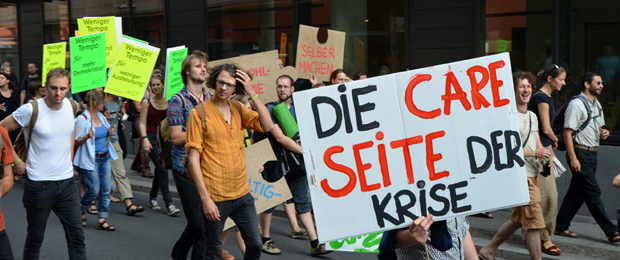
By Ulrich Schachtschneider A new star is born in the sky of the social movements: the degrowth-movement. The traditional left, however, observes this novelty somewhat critically – degrowth being a path that seems possible without the traditional left. Marxist, feminist and anti-racist analyses were largely missed at the latest Degrowth-Conference and where they were present, participants eyed ...