Cities • 26.08.2021
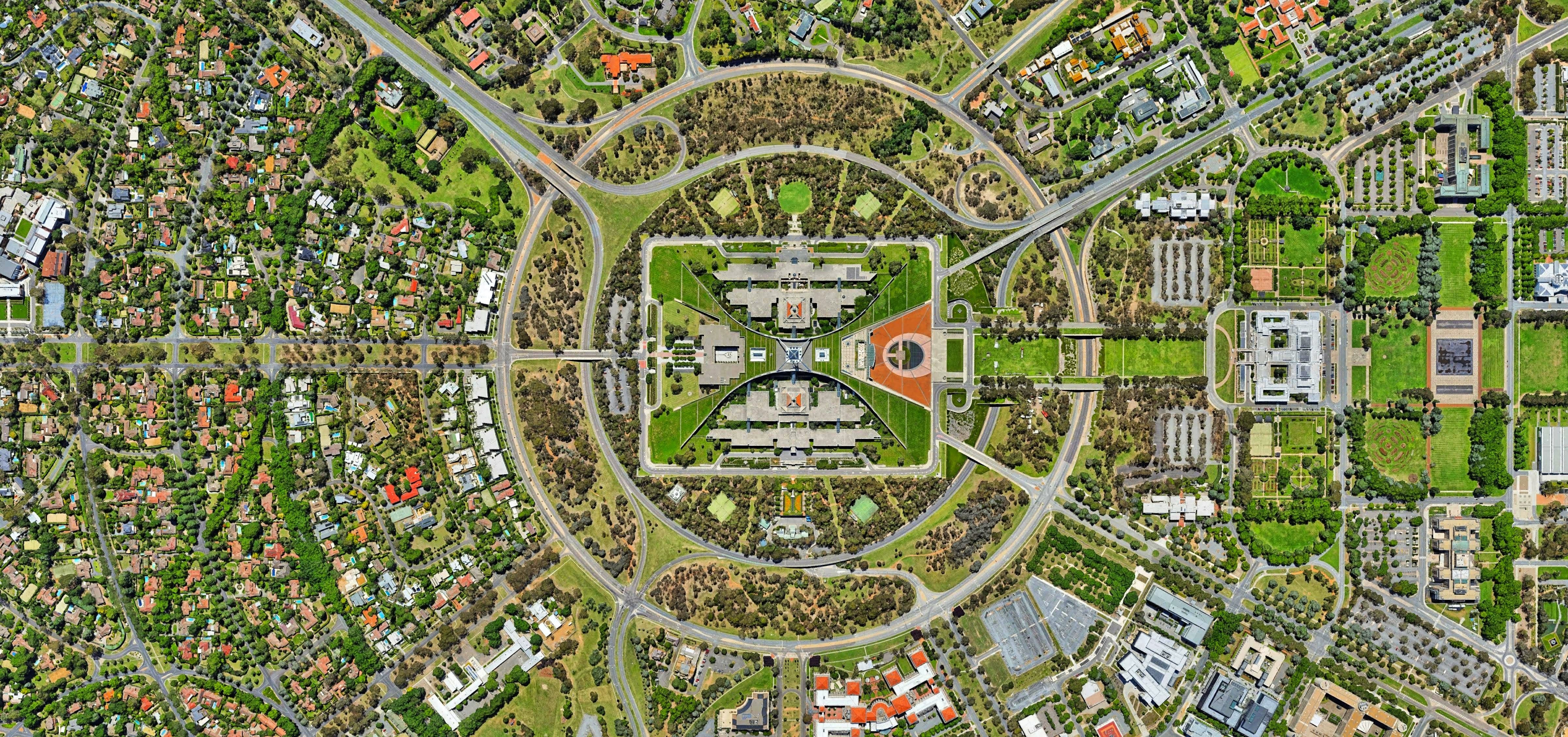
The idea of the ‘15-minute city’ has recently gained traction amongst policy-makers as an urban innovation with the potential to address intersecting social and ecological challenges of the post-COVID world. But its lack of an embedded politics presents a danger as much as it does an opportunity.
Strategy • 16.08.2021

Unless the future takes a bizarre turn, and humanity is united in one country under the flag of ‘DegrowthTopia’, in which the only ‘enemy’ that remains is the extra-terrestrial, the puzzle of how we relate and interact with those beyond our borders and communities will remain.
Strategy • 30.07.2021

The degrowth community has spent much time and effort making the case for why we need a degrowth transformation. Now it’s time to come together and pool the community’s knowledge on how to make such a social-ecological transformation happen. As an off-shoot of the Degrowth Vienna 2020 Conference, our book Degrowth & Strategy: how to bring about social-ecological transformation lays the groundwork for precisely this discussion. However, to bring this project to full fruition, we need your help.
Blog • 04.06.2021

This blog post analyzes press coverage of degrowth in Western European (English language) newspapers and magazines between January 2015 and October 2020. Using media theory concepts such as agenda setting and framing, it explores how degrowth is being considered in the press, particularly as a potential response to climate change.
Justice • 09.05.2021

Reconciling degrowth and law isn’t always easy, given the anarchist underpinnings and anti-statist leanings of some in the degrowth community. One vision of a degrowth world is of decentralized, autonomous, convivial communities of people in tune with their supporting ecosystems, consuming no more than they need, sharing as much as possible and treating each other with compassion, fairness and mutual respect. No central state power, no police, no borders, no masters and servants, no conspicuous consumption, no oppression. This, however, doesn’t necessarily require a world without law, just a world with law that is much different from the forms of law that prevail in today’s rapacious and unjust world.
Food • 05.04.2021
On October 1, 1960, as Nigeria gained independence, the population of the entire country was around 45.1 million. Fast forward to the year 2020, according to U.N, the estimated population of Nigeria is above 206 million. This can be seen as a rapidly exploding population when compared to other nations in Europe like UK (52.2 million in 1960 to 67.9million in year 2020) over the same period of t...
Money • 26.03.2021

GDP is a flawed guide to prosperity. What else should we measure if we want to do better? “The welfare of a nation can scarcely be inferred from a measurement of national income”. Those were the words of Simon Kuznets, who developed the first national income accounts in the United States. And yet, we look back on decades of appropriating GDP as a measure of social welfare and progress. With t...
Strategy • 05.03.2021
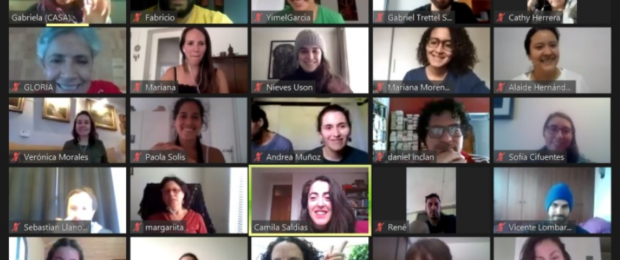
What does degrowth mean in the Latin American context? In 2020, a series of six self-organized encounters attempted to dive into this question. Each meeting reflected the metaphor of the agricultural process: from sowing to harvesting. Among the conclusions was a unanimous desire to put into practice ‘other ways of inhabiting the world’, valuing the knowledge of the original peoples and inhabit...
Care • 12.02.2021
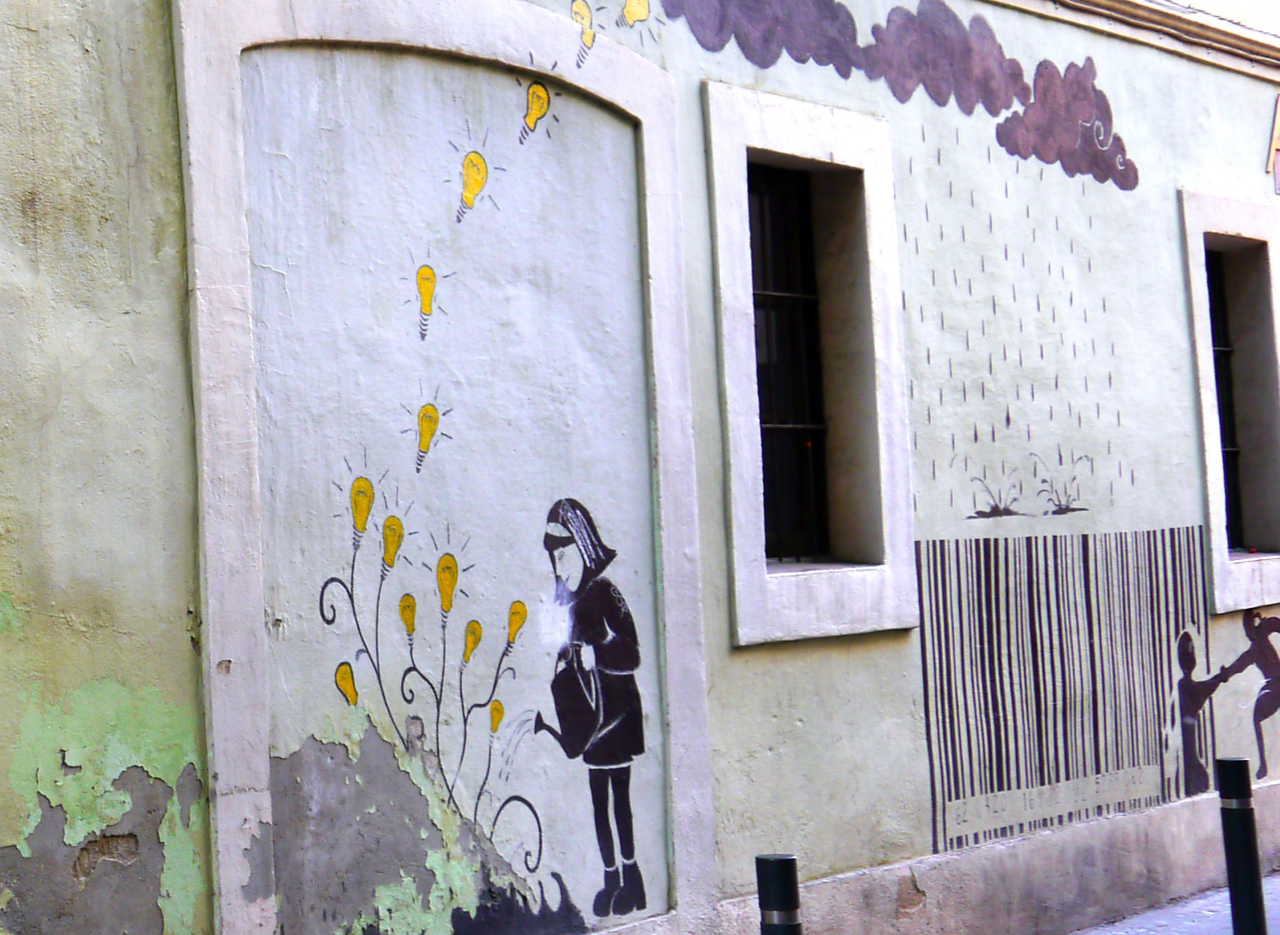
The third annual Global Degrowth Day on the theme of care will take place on 5th June 2021. Here, Corinna Dengler and Giacomo D'Alisa expand on the centrality of care to degrowth. Degrowth is an activist and political claim supported by academic research that aims at creating global human well-being within planetary boundaries. Degrowth problematizes interlinking systems of domination ...
Work • 03.02.2021
As the current default indicator for economic and social ‘progress’, GDP is the most broadly established measure of a country’s economic performance relative to that of other countries. Conceived as a tool to measure economic quantity, GDP is widely used to assess economic quality, although it ignores a range of vital economic activities, most notably care work. On top of that, the race for GD...
Strategy • 12.01.2021
As we look back on 2020 we see how Covid-19 has made it starkly clear to all of us that globally something is deeply, systemically wrong. As Arundhati Roy stated a portal has opened that demands we change our lives. Those of us cocooned at home working on zoomland, or those of us struggling with economic uncertainty and compromised health, have become even more aware of how important relations ...
Events • 14.12.2020
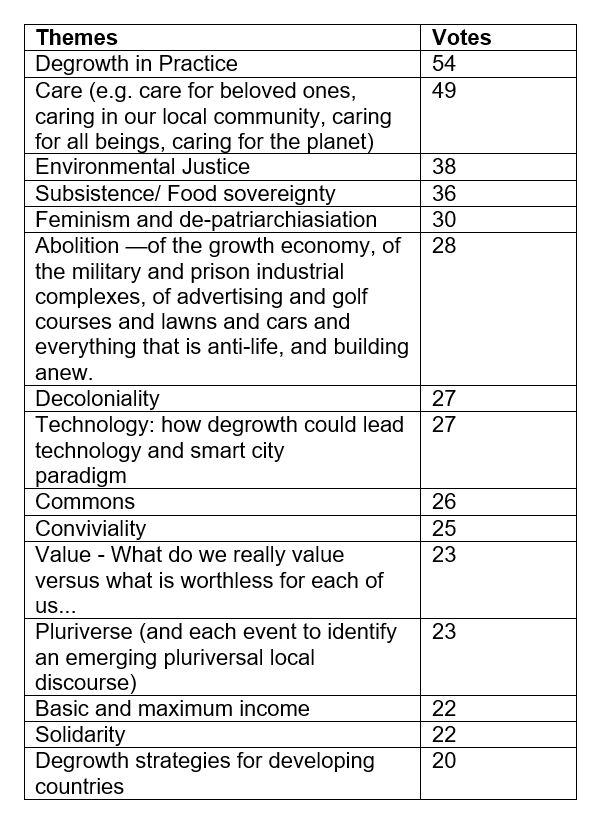
In this announcement, the Global Degrowth Day organising team talk through the selection of care as the theme for the 2021 edition of the event. In our search for a theme for next year’s Global Degrowth Day, taking place on June 5th 2021, we launched a call for ideas back in October, and a poll in November. These were the results: The results reflect the multiple angles and aspira...